
Traveling to Korea with Diabetes: Insulin, Medication & Food Guide (2026)

Traveling to Korea with diabetes is absolutely possible, but there are a few things worth preparing before you get on the plane.
The difficult part is usually not finding food or medical care in Korea. It is managing the things that change when you travel—long flights, time-zone differences, much more walking than usual, unfamiliar meals, and keeping insulin or other medication stored correctly.
If you use insulin, a pump, CGM, needles, or prescription medication, you may also have questions before your trip: Can I bring insulin into Korea? Should it go in my carry-on? Do I need a doctor’s letter? What happens at airport security? And what should I eat when rice, noodles, and sweet sauces are everywhere?
In this guide, I’ll walk through the practical things I would prepare before traveling to Korea with diabetes—from medication and airport security to Korean food, useful Korean phrases, and what to do if you need medical help during your trip.
One important note: medication rules and individual diabetes treatment plans are not something to guess about. Use this guide to prepare for your trip, but confirm medication entry requirements with the relevant Korean authorities and follow your own clinician’s instructions for insulin, medication, and glucose management.
Yes. People with diabetes can travel independently in Korea, including travelers who use insulin, injections, pumps, CGMs, or other prescription medication.
- Medication: Keep essential diabetes medication and supplies with you rather than relying on checked luggage.
- Documents: Keep medication in its original labeled packaging and bring supporting prescription or medical documentation.
- Controlled medication: Some medicines may require advance approval before entering Korea, so check the active ingredient—not just the brand name—before you travel.
- Insulin storage: Follow the storage instructions for your exact insulin or medication and protect it from excessive heat and freezing.
- Korean food: You do not need to avoid Korean food. Rice, noodles, rice cakes, sweet sauces, and portion sizes are the main things to account for according to your own diabetes plan.
- Emergency: If you have a serious medical emergency in Korea, call 119.
- Before You Travel: Prepare for Korea with Diabetes
- Bringing Insulin and Medication into Korea
- How to Pack Insulin and Diabetes Supplies
- Airport Security: Insulin, Needles, Pumps and CGMs
- Managing Diabetes While Traveling in Korea
- Korean Food Tips for Travelers with Diabetes
- Medical Emergencies in Korea
- Common Mistakes to Avoid
- Pre-Flight Checklist
- Frequently Asked Questions
Before You Travel: Prepare for Korea with Diabetes
Korea can involve much more walking than many first-time visitors expect. A normal sightseeing day in Seoul may include long subway transfers, stairs, palace grounds, markets, hills, and several neighborhoods in one day.
Add jet lag, unfamiliar meal times, and a long flight, and your normal routine can change quickly. That is why I would prepare the medical side of the trip before building a packed sightseeing schedule.
Talk to Your Clinician Before the Trip
If you use insulin or other medication that depends on timing, talk with your doctor or diabetes care team before departure about how to handle the time difference between your home country and Korea.
Ask specifically about long flights, delayed meals, increased walking, sick days, and what to do if your normal medication schedule is disrupted. Do not create your own insulin adjustment plan based only on general travel advice online.
It is also useful to carry a short medical letter in English listing your condition, medications by generic name, doses, devices, and the medical supplies you need to carry.
Keep Your First Day in Korea Simple
If you arrive after a long international flight, I would avoid turning your first day into a full sightseeing day.
Get to your hotel, eat, hydrate, check that your medication and devices are fine, and give yourself time to adjust to the time difference. Adding an immediate domestic flight, long train journey, or packed evening itinerary can make an already tiring arrival much harder.
Check Medication Storage Before Booking Your Hotel
If your medication requires refrigeration, contact the hotel before you book and ask exactly what is available.
Do not assume that every minibar or small room refrigerator is suitable for medication. Ask whether the room has appropriate refrigerator storage and whether hotel staff can provide secure refrigerated storage if necessary.
Most importantly, follow the storage instructions for your exact medication. Different insulin and injectable products can have different temperature and storage requirements.
Bringing Insulin and Medication into Korea
If you are bringing diabetes medication into Korea, the most important thing is to know exactly what you are carrying. Check the active ingredient, not only the brand name.
Korea treats ordinary personal-use medication differently from medicines containing controlled narcotic or psychotropic substances. A medication that is routinely prescribed in your home country can still be regulated differently in Korea.
| What You Are Carrying | What to Prepare | Important |
|---|---|---|
| Insulin and standard non-controlled diabetes medication | Keep the medicine in its original labeled packaging and carry documentation showing that it is for your personal medical use. | Korean guidance for non-narcotic personal-use medicine generally allows up to six bottles or up to a three-month supply. |
| Needles, injection supplies and diabetes devices | Keep them together with the medication and supporting medical documentation. | Airport security rules can differ from Customs rules, so we will cover screening separately below. |
| Medication containing narcotic or psychotropic substances | Check whether you need approval from Korea’s Ministry of Food and Drug Safety (MFDS) before traveling. | A prescription from your home country does not automatically replace Korean approval requirements. |
| CBD, cannabis-derived products or medication with an unclear ingredient | Check directly with the relevant Korean authority before packing it. | Do not assume a product is permitted in Korea simply because it is legal or sold over the counter in your home country. |
Check the Active Ingredient, Not Just the Brand Name
This matters especially if you take medication in addition to your diabetes treatment. Some medicines used for ADHD, anxiety, sleep, or pain can contain ingredients that are controlled in Korea.
Before you fly, make a list of every prescription medicine you plan to bring and write down both the brand name and active ingredient. If an ingredient may be controlled, check the current Korean rules before departure.
What Documents Should You Carry?
For personal-use medication, keep the original packaging and bring evidence showing that the medicine belongs to you and is being used for medical treatment.
Useful documents can include a prescription, medical certificate, pharmacy label, and a short clinician letter in English. Keep these documents somewhere easy to reach when you arrive rather than buried at the bottom of your luggage.
How to Pack Insulin and Diabetes Supplies
When packing for Korea, I would treat essential diabetes supplies differently from ordinary travel items. If losing something for a day or two could seriously disrupt your treatment, keep it with you rather than depending on checked luggage.
The goal is not to pack your entire medicine cabinet. It is to make sure your essential medication, monitoring supplies, documents, and realistic backups remain accessible throughout the flight and your arrival in Korea.

Carry-On Packing Checklist
- Insulin and other essential diabetes medication in their original labeled packaging
- Needles, pen needles, infusion sets, reservoirs, sensors, test strips, lancets, batteries, and chargers that you normally use
- A backup glucose-monitoring option if it is part of your normal diabetes plan
- Backup supplies for your usual medication or insulin-delivery method, based on the plan you have discussed with your healthcare team
- Your usual fast-acting glucose treatment for hypoglycemia
- Food or snacks appropriate for unexpected flight, train, or meal delays
- Glucagon and ketone-testing supplies if they are part of your prescribed diabetes plan
- Prescription copies, medical documentation, travel insurance details, and any Korean medication approval required for your trip
- A suitable container for safely storing used needles or other sharps
Keep Insulin at the Correct Temperature
Temperature-sensitive medication needs more care than simply putting it next to an ice pack.
Follow the storage instructions for your exact insulin or injectable medication. Protect it from excessive heat and direct sunlight, but also avoid freezing it. Different products can have different storage limits, including how long they may be kept at room temperature.
If you use an insulated medication pouch or cooling pack, keep the medication protected from direct contact with anything that could freeze it. Before departure, check the manufacturer’s storage instructions for every temperature-sensitive medication you are carrying.
Airport Security: Insulin, Needles, Pumps and CGMs
Airport security is usually much easier when your diabetes supplies are organized and easy to explain. Keep medication, medical liquids, needles, devices, cooling supplies, and supporting documents together rather than scattered throughout your luggage.
Security rules depend on the country and airport you are departing from or connecting through. If you are flying from the United States, medically necessary diabetes supplies and liquids are handled under TSA medical-item rules. If you depart from another country, check that airport’s current security guidance before your trip.
A Simple Airport Security Routine
- Keep your diabetes medication and supplies somewhere you can reach easily.
- Tell the security officer that you are carrying diabetes medication and medical supplies when necessary.
- Keep needles and injection supplies together with the medication they are used for.
- Have prescriptions or medical documentation available if questions arise.
- Keep your usual treatment for low blood sugar accessible during the flight rather than in an overhead bag you cannot easily reach.
- If you use an insulin pump or CGM, check the manufacturer’s airport-screening instructions for your exact device before departure.
Security and Korean Customs Are Different
Airport security screening and entering Korea through Customs are two separate processes.
Security is concerned with what can safely pass through the airport and onto the aircraft. Korean Customs is concerned with what you are legally bringing into the country.
When you arrive in Korea, keep your medication labels, prescription or medical documentation, and any required MFDS approval easy to access until you have completed the arrival process.
Managing Diabetes While Traveling in Korea
Once you arrive in Korea, one of the biggest changes may simply be how much you walk.
A day that looks easy on a map can include subway stairs, long station transfers, palace grounds, markets, hills, shopping streets, and several blocks between attractions. Jet lag and different meal times can add another change to your normal routine.
Expect More Walking Than You Think
Keep the supplies you normally need for low blood sugar in the bag or pocket you carry throughout the day rather than leaving everything at your hotel.
During the first few days, pay particular attention to how the combination of extra walking, unfamiliar meals, jet lag, and a different daily schedule affects you. Follow the glucose-monitoring and treatment plan you have already discussed with your healthcare team.
Build Meals and Rest Stops into Your Route
Do not wait until you are already exhausted or extremely hungry to start looking for somewhere to eat.
A practical Korea itinerary can include breakfast near your hotel, a planned lunch between major attractions, a café or rest stop in the afternoon, and food or snacks available before a long train or bus journey.
This does not mean you need to schedule every meal precisely. It simply gives you more control than trying to find food after a long subway transfer or in the middle of a packed sightseeing day.
Use Phone Alarms for Your Normal Routine
A long flight and a large time difference can make familiar routines surprisingly easy to lose track of.
Use phone alarms or reminders for the medication, meals, device charging, sensor changes, or other routine tasks that are already part of your diabetes plan.
If your medication timing needs to change because of the time difference, follow the plan provided by your healthcare professional rather than improvising a new schedule after arrival.
Do Not Depend on Buying Your Exact Supplies in Korea
Korea has pharmacies, clinics, and hospitals throughout major cities, but that does not mean your exact medication or device supply will be immediately available.
Brand names can differ, some medicines may require a local prescription, and specialized pump or CGM supplies may not match the device you brought from home.
For that reason, I would arrive with the medication and supplies you realistically need for your trip, along with appropriate backups, rather than planning to replace essential items after you arrive.
Korean Food Tips for Travelers with Diabetes
Having diabetes does not mean you need to miss out on Korean food. The more practical approach is to understand what is on the table and make food choices according to the diabetes plan that already works for you.
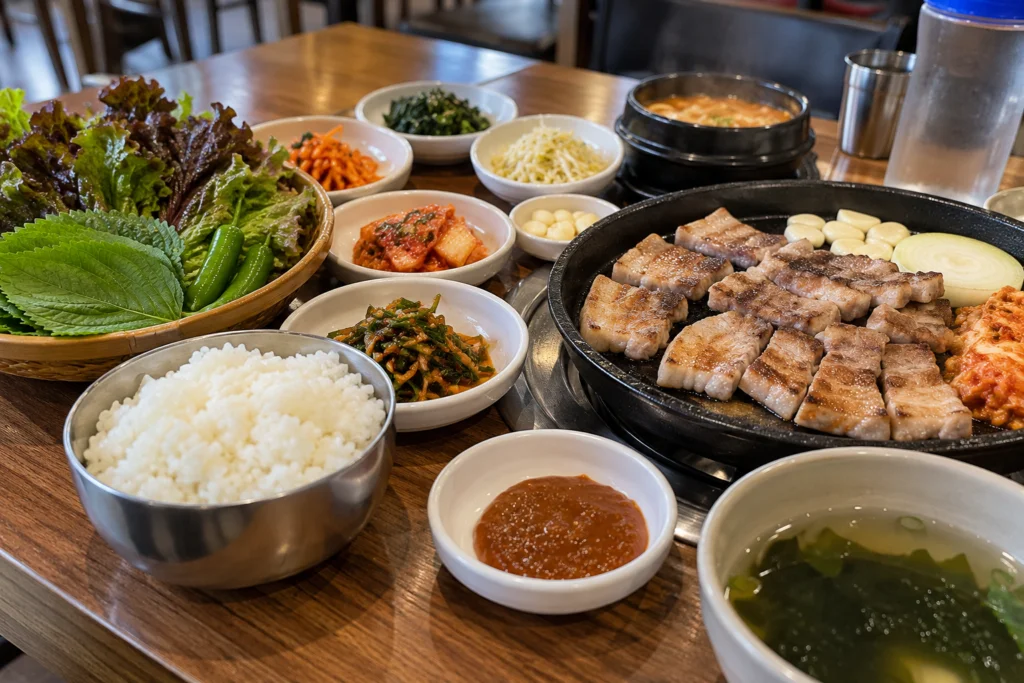
Rice, noodles, rice cakes, sweetened sauces, marinades, and drinks can be important carbohydrate sources in Korean meals. The useful part is that rice and many sauces are often served separately, which can make portions easier to see and adjust.
| Korean Food | What to Notice | Practical Option |
|---|---|---|
| Bibimbap | Rice makes up much of the meal, and gochujang may contain added sugar. | Ask for the sauce separately and decide how much rice and sauce fits your usual plan. |
| Korean BBQ | Marinades and dipping sauces may be sweet, while rice, noodles, and alcohol add to the meal. | Plain grilled options can make the meal easier to understand, with rice and sauces handled separately. |
| Soups & Stews | Do not forget the bowl of rice that is commonly served alongside the soup or stew. | Treat the rice as a separate part of the meal rather than assuming the soup is the whole meal. |
| Kimbap | Vegetables are visible, but rice still makes up a large part of most rolls. | Think of it as a rice-based meal or snack rather than automatically treating it as a light option. |
| Tteokbokki | Rice cakes and sweet-spicy sauce can make it a concentrated carbohydrate choice. | Account for both the rice cakes and sauce according to your normal meal plan. |
| Korean Fried Chicken | Breading and sticky sauces can make the carbohydrate content harder to estimate. | Unsauced chicken or sauce on the side may make the meal easier to assess when available. |
Convenience Stores Can Be Useful
Korean convenience stores are everywhere and can be useful when your sightseeing schedule changes unexpectedly.
You can usually find water, eggs, nuts, cheese, yogurt, fruit, packaged meals, drinks, and snacks. But products that look light or healthy can still contain more sugar or carbohydrate than you expect, so check the nutrition label when it matters to your diabetes plan.
A phone translation app can help you read Korean nutrition labels, but keep a familiar treatment for low blood sugar with you instead of depending on finding a particular product after you need it.
Useful Korean Phrases to Save on Your Phone
You do not need to memorize these. Save them on your phone so you can say or show them when necessary.
Medical Emergencies in Korea
Hopefully you will never need emergency medical care during your trip, but save the important numbers before you arrive in Korea.
If you have a serious medical emergency, severe symptoms, or cannot safely manage the situation yourself, seek professional medical help rather than relying on a translation app or general online advice.
Emergency Korean Phrases to Save on Your Phone
You do not need to memorize these. Save them on your phone so you can show the screen to someone nearby if speaking becomes difficult.
Common Mistakes to Avoid
Most problems are easier to deal with when you prepare before leaving home. These are the mistakes I would especially avoid when traveling to Korea with diabetes.
1. Putting Essential Medication in Checked Luggage
Do not depend on a checked suitcase for medication and supplies you may need during the flight or immediately after arrival. Bags can be delayed, misplaced, or exposed to unsuitable temperatures.
2. Checking Only the Brand Name of Your Medication
Medication names vary between countries. Check the active ingredient of every prescription medicine you plan to bring, especially if you use medication in addition to your diabetes treatment.
3. Accidentally Freezing Insulin
Keeping insulin cool does not mean freezing it. Avoid direct contact with frozen cooling packs unless the storage system is specifically designed to prevent freezing, and follow the instructions for your exact medication.
4. Underestimating How Much You Will Walk
Subway transfers, stairs, markets, palaces, shopping districts, and hills can add much more walking to your day than expected. Account for that extra activity using the diabetes-management plan you already follow.
5. Assuming You Can Replace Everything in Korea
Korea has excellent medical facilities, but your exact insulin, pump supplies, CGM sensors, or other specialized items may not be immediately available. Bring the supplies and appropriate backups you expect to need.
6. Planning Too Much on Your Arrival Day
A long flight, time-zone change, airport transfer, unfamiliar meals, and fatigue are already enough for one day. Give yourself time to settle in before starting a packed sightseeing schedule.
Pre-Flight Checklist for Korea
A few days before your flight, run through this list one final time. It is much easier to fix a missing document or medication question at home than after you arrive at the airport.
☐ Discuss time-zone and medication timing with your healthcare professional if necessary.
☐ Check the active ingredient of every prescription medicine you are bringing.
☐ Confirm whether any medication requires advance approval to enter Korea.
☐ Keep medication in its original labeled packaging.
☐ Pack essential medication and diabetes supplies in your carry-on.
☐ Bring appropriate backup medication, monitoring supplies, batteries, chargers, sensors, and other items you normally depend on.
☐ Carry prescriptions, medical documentation, and any required Korean approval documents.
☐ Check the storage instructions for your exact insulin or other temperature-sensitive medication.
☐ Check the airport-screening instructions for your exact pump or CGM.
☐ Pack your usual treatment for low blood sugar somewhere easy to reach.
☐ Confirm your travel insurance coverage and save the contact details offline.
☐ Save your hotel name and address in both English and Korean.
☐ Save Korea’s emergency number 119 on your phone.
☐ Keep digital copies of important medical and travel documents available offline.
Frequently Asked Questions
Can I bring insulin into Korea?
Yes. Travelers can bring personal-use insulin into Korea. Keep it in its original labeled packaging and carry documentation showing that it is for your medical use. I recommend keeping essential insulin in your carry-on rather than checked luggage.
Do I need a doctor’s letter to bring insulin to Korea?
A short medical letter is useful even when it is not the only acceptable form of documentation. It can explain your condition, medication, needles, pump, CGM, or other supplies if questions come up during your journey.
A prescription, medical certificate, or pharmacy label can also help document that medication is for your personal use.
Can I bring needles and injection supplies?
If you need needles or injection supplies for your diabetes treatment, keep them organized with the medication they are used for and carry supporting medical documentation. Also check the security rules for every airport you will pass through.
Do I need Korean approval for my medication?
It depends on the active ingredient. Ordinary personal-use medication and controlled narcotic or psychotropic medication are treated differently in Korea.
Some controlled medicines require advance approval from Korea’s Ministry of Food and Drug Safety (MFDS), even if you have a valid prescription in your home country. Check the active ingredient before traveling.
Can I buy insulin or CGM supplies in Korea if I run out?
Do not depend on this as your main plan. The exact brand or device supply you use at home may not be immediately available, and some medication may require a consultation or prescription in Korea.
Bring enough medication and appropriate backup supplies for your trip based on your own treatment plan.
Can I travel to Korea with an insulin pump or CGM?
Yes, but check the airport-screening instructions provided by the manufacturer of your exact pump or CGM before departure. Screening guidance can differ between devices.
What about Ozempic, Mounjaro, Wegovy, or other injectable medication?
Keep prescribed injectable medication in its original packaging and follow the manufacturer’s storage instructions for that specific product. Do not assume that its temperature limits are the same as insulin.
If you are unsure whether an ingredient is controlled in Korea, confirm the current entry requirements before flying.
Is Korean food manageable for travelers with diabetes?
Korean food can be included in a trip according to your individual diabetes plan. Pay attention to rice, noodles, rice cakes, sweetened sauces, marinades, drinks, and portion sizes rather than assuming an entire Korean dish is either “good” or “bad.”
What number should I call for a medical emergency in Korea?
Call 119 for an ambulance, fire, or emergency rescue in Korea. Save the number on your phone before your trip.
Final Takeaway
Traveling to Korea with diabetes does require a little more preparation, but it should not stop you from enjoying the trip.
Before you fly, know exactly what medication you are bringing, keep essential supplies accessible, prepare the right documents, check storage requirements, and understand any Korean rules that apply to your medication.
Once you arrive, the biggest adjustments may be surprisingly ordinary ones: walking more than expected, eating at different times, dealing with jet lag, and figuring out unfamiliar meals.
Prepare the medical details before your trip so you can spend less time worrying about them once you are in Korea.
For the rest of your trip planning, I recommend learning the basics of the Seoul subway and setting up your Korea eSIM before arrival. Having mobile data and knowing how to get around will make the practical side of your first few days much easier.
Then you can focus on what you came to Korea for—exploring new neighborhoods, trying Korean food, and enjoying the trip at a pace that works for you.