
How to Use ChatGPT in Korea: 15+ Essential Prompts for Your First Trip (2026)

Using ChatGPT in Korea can make your first trip much easier when small travel problems suddenly come up. You may know exactly where you want to go, but then find yourself standing inside a huge subway station wondering which exit to take, looking at a Korean menu you cannot read, or trying to explain something to a taxi driver.
This is where ChatGPT can actually be useful while traveling in Korea.
Instead of asking broad questions like “How do I get to Hongdae?”, you can use a few specific prompts to get clearer subway directions, translate a restaurant request, understand Korean etiquette, or prepare a short Korean sentence when you need help.
In this guide, I’ll show you the ChatGPT prompts I would actually recommend to a first-time visitor to Korea—including prompts for subways, restaurants, Korean etiquette, and emergencies.
There is one important rule, though: do not treat ChatGPT as the final source for live information. Last-train times, restaurant opening hours, closures, prices, and emergency information can change. I’ll show you what ChatGPT is useful for, and what you should always verify separately.
ChatGPT is most useful in Korea when you give it a specific situation instead of asking a general travel question.
- Subway: Ask for the line, direction, transfer station, exit number, and a Korean sentence to show station staff.
- Restaurants: Use it to translate menus and prepare short questions about ingredients, allergies, or dietary needs.
- Etiquette: Ask what is expected in a specific situation instead of relying on a long list of general Korean customs.
- Live information: Always verify last trains, opening hours, closures, prices, and availability with a current source.
- Emergency: If there is immediate danger, call 112 for police or 119 for fire or ambulance first. Do not wait for an AI response.
Set Up ChatGPT for Your Korea Trip
Before you start copying individual prompts, there is one simple way to make ChatGPT much more useful during your trip: give it your exact situation.
For example, asking “How do I get to Hongdae?” is not very specific. Your answer could change depending on whether you are at Incheon Airport, Seoul Station, Myeongdong, or somewhere else.
A better question would be:
The more useful details you provide, the less likely you are to get a vague answer.
What to Include in a Korea Travel Prompt
| Include | Example | Why It Helps |
|---|---|---|
| Starting point | Seoul Station | Routes depend on exactly where you start. |
| Destination | Gyeongbokgung Palace (경복궁) | Korean names can help when checking signs or maps. |
| Your situation | One suitcase / fewest stairs | The fastest route is not always the easiest route. |
| Answer format | Line / direction / transfer / exit | Short directions are easier to follow while moving. |
| What to verify | “Tell me what I should check live.” | Schedules, closures, and availability can change. |
Save This Prompt Before You Fly
Copy this into ChatGPT:
You are my Korea trip assistant. Keep your answers practical and brief.
For any route, give me:
1. Starting station and destination station
2. Subway line and train direction
3. Transfer station if needed
4. Best exit number
5. A short Korean sentence I can show staff
6. Anything I need to verify in a live map or transit app
If you are uncertain, tell me instead of guessing.
Once you know your hotel, add the hotel name and address in both English and Korean to a note on your phone. This is especially useful when you need directions, take a taxi, or ask someone for help.
ChatGPT Prompts for the Subway
Seoul’s subway system is convenient, but the confusing part for a first-time visitor is often not finding the station. It is figuring out which direction to take, where to transfer, and which exit to use when you arrive.
This is where ChatGPT can help simplify the route. Instead of asking only which subway line to take, ask for the entire trip in a format you can follow while standing inside the station.

5 Things to Check Before You Board
- Station: Confirm the exact station name. Some destinations have similar names, so check the Korean name too when possible.
- Line: Check the subway line number or name instead of relying only on the color.
- Direction: Look at the stations shown in the direction your train is traveling. This helps prevent getting on the correct line in the wrong direction.
- Transfer: Know which station you need to change at and which line you are transferring to.
- Exit: Check the exit number before leaving the station. At large stations, choosing the wrong exit can add a surprisingly long walk.
Prompt #1 — Find the Easiest Subway Route
Copy this prompt:
I am at [START STATION] in Seoul and need to get to [DESTINATION].
Give me the easiest subway route for a first-time visitor.
Please include:
• subway line
• train direction
• transfer station, if needed
• approximate number of stops
• best exit number for my destination
• whether there are long walks or many stairs
• one short Korean sentence I can show a station employee
Flag anything I should verify in a live transit app.
Prompt #2 — Find the Best Exit with Luggage
Copy this prompt:
I am at [STATION NAME] and my hotel is [HOTEL NAME / ADDRESS].
Which exit should I take for the easiest walk with one suitcase?
Give me:
• exit number
• walking direction
• a landmark to look for
• whether there is an elevator or a lot of stairs
• my destination in Korean to show someone if I get lost
Prompt #3 — When You Might Miss the Last Subway
Copy this prompt:
I may miss the last subway from [AREA] to [HOTEL AREA] tonight.
Do not guess the final train time.
Tell me:
• what I should check in a live transit app
• which station and line I should check
• what taxi information I should prepare
• a simple backup plan if the subway has already stopped running
If Seoul’s subway system itself still feels confusing, read my Seoul Subway Guide . It covers the basics you should know before using the subway for the first time.
ChatGPT Prompts for Restaurants
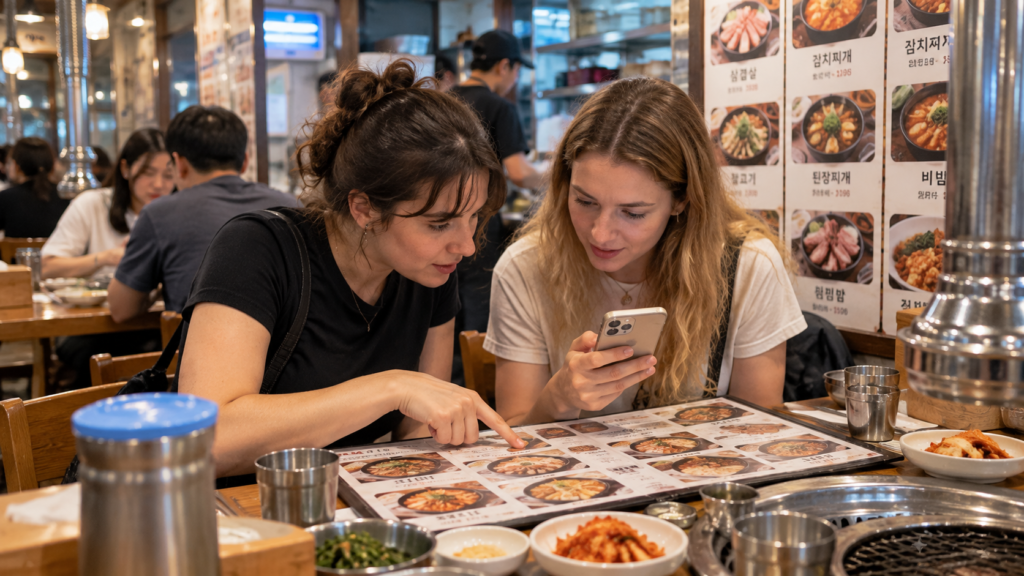
Ordering food in Korea is usually easier than it first looks, but a Korean-only menu can still be intimidating when you are hungry and trying to decide quickly.
ChatGPT is especially useful here for translating a menu, preparing a short question for restaurant staff, and explaining ingredients you may need to avoid. The key is to ask a specific question instead of simply uploading a menu and asking, “What should I eat?”
Be Specific About Dietary Needs
If you have an allergy or follow a vegetarian, halal, pork-free, or other restricted diet, do not ask only whether a dish contains “meat.”
Broth, sauce, fish sauce, seafood, egg, dairy, alcohol, or ingredients prepared in advance may not be obvious from the menu. If the restriction is important, use ChatGPT to prepare the question—but confirm the answer with the restaurant before eating.
- Does this contain pork, beef, chicken, seafood, egg, dairy, or alcohol?
- Is the broth made with meat, seafood, or fish?
- Can the ingredient actually be removed, or is the dish prepared in advance?
- Is there a minimum order for one person?
- Is there an option that fits my dietary restriction?
Prompt #4 — Translate a Korean Menu
Copy this prompt:
I am looking at a Korean restaurant menu. I will upload a photo of it.
Please:
• translate the main dishes into simple English
• explain what each dish is
• tell me whether it is usually spicy
• identify any ingredients that may not be obvious
• recommend 3 dishes that would be easy for a first-time visitor to Korea to try
If something cannot be confirmed from the menu, tell me instead of guessing.
Prompt #5 — Ask About an Allergy or Ingredient
Copy this prompt:
I cannot eat [INGREDIENT].
Write a short and polite Korean message I can show restaurant staff asking:
“Does this dish contain [INGREDIENT], including in the broth or sauce? If it does, is there another dish you recommend?”
Show me:
1. Korean
2. simple pronunciation
3. English meaning
Keep the Korean sentence short enough to show on my phone.
Prompt #6 — Find a Meal When You Are Traveling Alone
Copy this prompt:
I am traveling alone in Korea and I am near [NEIGHBORHOOD] at [TIME].
Suggest 3 types of Korean meals that are usually practical for one person.
For each one, tell me:
• what type of dish to look for
• what I should ask before entering
• whether it is usually spicy
• whether restaurants may require a minimum order
• a simple Korean sentence I can use when ordering
If you are still deciding what to eat, see my Best Restaurants in Seoul guide for practical restaurant options you can fit into a first Seoul itinerary.
ChatGPT Prompts for Korean Etiquette
You do not need to memorize dozens of Korean etiquette rules before your trip. For most first-time visitors, being observant, polite, and willing to follow the people around you is enough.
ChatGPT can be useful when you are unsure about a specific situation—for example, visiting a Korean home, eating barbecue with local friends, entering a traditional space, or wondering whether you should remove your shoes.
Everyday Etiquette: A Simple Starting Point
| Situation | Good Default | Do Not Assume |
|---|---|---|
| Subway | Let passengers get off before you board. | That every seat should be treated the same; be mindful of priority seating. |
| Restaurant | Use the table call button if there is one, or politely get a staff member’s attention. | That staff will repeatedly check your table. |
| Eating with locals | Watch the host and follow their lead if you are unsure. | That you must drink alcohol or accept everything offered. |
| Korean home | Look at what people do with their shoes and follow the host. | That the same shoe rule applies to every indoor space. |
| Taking photos | Ask before taking a close photo of another person. | That being in a public place automatically means someone wants to be photographed. |
Prompt #7 — Before Visiting an Unfamiliar Place
Copy this prompt:
I am about to visit a [KOREAN BARBECUE RESTAURANT / TEMPLE / TRADITIONAL TEA HOUSE / KOREAN HOME / SAUNA].
Give me a short etiquette guide for a first-time visitor.
Tell me:
• what I should do when entering
• what I should avoid
• whether I may need to remove my shoes
• 2 useful Korean phrases
• which customs are important and which are optional
Keep it practical and do not make Korean customs sound like strict rules if they are not.
Prompt #8 — Dinner with a Korean Friend or Colleague
Copy this prompt:
I am meeting a Korean friend or colleague for dinner for the first time.
Explain the basic etiquette for:
• greeting them
• sharing food
• receiving or pouring drinks
• paying the bill
• saying goodbye
Tell me what is a polite default and what depends on the situation.
Keep it practical for a foreign visitor.
Prompt #9 — Make a Polite Korean Sentence
Copy this prompt:
Translate these sentences into simple, polite Korean for a traveler:
“Excuse me, may I ask a quick question?”
“Thank you for your help.”
“I’m sorry, I don’t understand. Could you please show me?”
For each sentence, give me:
1. Korean
2. simple pronunciation
3. English meaning
Use natural Korean that I can actually show or say to someone.
You do not need to memorize these. Save them on your phone so you can say or show them when you need help.
First-Day Korea Prompt Checklist
Your first few hours in Korea are when small problems can feel the most stressful. You may be tired after a long flight, unfamiliar with the transportation system, and still getting your phone and payment methods ready.
Before leaving the airport, use the Wi-Fi to save a few important details on your phone. The goal is simple: you should still be able to reach your hotel and ask for help even if your mobile data stops working.
Prompt #13 — Plan Your First Evening in Korea
Copy this prompt:
I have just arrived in Korea and I am staying at [HOTEL NAME / AREA].
Make me a simple first-evening checklist for a tired first-time visitor.
Include:
• getting from my current location to the hotel
• what transportation information I should verify live
• buying or topping up a transit card if needed
• finding a simple meal near my hotel
• finding a nearby convenience store
• saving emergency information
• anything important I should prepare for tomorrow morning
Keep the plan simple. I do not want a busy sightseeing itinerary on my arrival night.
Prompt #14 — Check What You Still Need After Arrival
Copy this prompt:
This is my first trip to Korea. I have arrived at my hotel in [AREA].
Ask me 7 short yes-or-no questions to check whether I am ready for the next few days.
Check things such as:
• mobile data
• transportation
• payment methods
• hotel address saved offline
• emergency information
• tomorrow’s route
• any reservations I should confirm
After I answer, give me only the things I still need to do.
If you have not arranged mobile data yet, compare your options before departure in my Korea eSIM Guide 2026 .
Common Mistakes to Avoid
ChatGPT can make small travel problems easier, but it becomes much less useful when the question is too vague or when you expect it to replace live information.
1. Asking for the “best exit” without giving your destination
There is no single best exit from a subway station. Give your hotel, attraction, street address, or map location so ChatGPT knows where you are actually trying to walk.
2. Treating a menu translation as an allergy guarantee
A translated menu may not tell you everything about broth, sauces, shared cooking surfaces, or ingredients prepared in advance. Use ChatGPT to prepare your question, then confirm it with restaurant staff.
3. Trusting an AI answer for the last subway
Last-train times and service conditions can change. Ask ChatGPT what you need to check, then confirm the actual time in a current transit source before heading to the station.
4. Using ChatGPT before calling for emergency help
If you are in immediate danger, do not spend time writing the perfect prompt. Call 112 for police or 119 for ambulance, fire, or rescue first.
5. Treating Korean etiquette as a list of strict rules
A Korean home, office, barbecue restaurant, café, temple, and night out with friends can all feel different. Ask about the specific situation and follow the people around you when you are unsure.
6. Sharing more personal information than necessary
You usually do not need to enter your full passport number, card number, booking reference, or other sensitive information just to get travel help. Share only the information needed for the question.
Frequently Asked Questions
Can ChatGPT give me live subway information in Korea?
ChatGPT can help explain a subway route, transfer, train direction, or what information you should look for. However, do not rely on it alone for live arrival times, service disruptions, platform changes, or the last train. Check those details with a current transit source or station information.
Can ChatGPT translate a Korean restaurant menu?
Yes. You can upload a photo of a Korean menu and ask ChatGPT to translate dishes and explain unfamiliar ingredients. This can be very useful when a restaurant does not have an English menu.
If you have a serious allergy or dietary restriction, however, do not assume an AI translation means a dish is safe. Ask restaurant staff to confirm the ingredients, broth, sauces, and preparation.
Can I use ChatGPT in Korea if I cannot speak Korean?
Yes. One of the most useful ways to use ChatGPT during a Korea trip is to create short Korean sentences you can show someone on your phone.
Ask for the Korean sentence, simple pronunciation, and English meaning. This works especially well for asking directions, ordering food, explaining dietary needs, or requesting basic help.
Can I show a ChatGPT translation directly to Korean staff?
For simple travel questions, yes. Keep the message short and specific. A one-sentence request is usually easier to understand than a long translated paragraph.
For important information such as allergies, medical issues, legal matters, or emergencies, treat the translation as communication assistance rather than guaranteed professional translation.
Should I use ChatGPT during an emergency in Korea?
Not before calling for help. If there is an immediate threat to your safety, call 112 for police or 119 for ambulance, fire, or rescue first.
Once help is on the way—or if you are already in a safe place—ChatGPT can help you prepare a short Korean message, organize the information you need to provide, or understand what to do next.
The Practical Way to Use ChatGPT in Korea
You do not need ChatGPT for every part of your trip to Korea. Where it becomes genuinely useful is in those small moments when you know what you want to do but are not sure what to do next.
Use it to turn a confusing subway route into a few simple steps, translate a short restaurant question, understand an unfamiliar Korean custom, or prepare a sentence you can show someone when you need help.
The best results come from giving ChatGPT your exact situation, location, destination, and what kind of answer you need. And whenever the information can change—such as train times, opening hours, prices, availability, or emergency information—verify it with a current source.
Use ChatGPT to understand, translate, prepare, and solve small problems.
Use live and official sources to confirm information that can change.
If this is your first trip to Korea, I recommend preparing two things before you fly: set up your mobile data and learn the basics of using the Seoul subway. With those ready, many of the prompts in this guide become much easier to use once you arrive.
Save the prompts you think you will actually use on your phone before departure. You probably will not need all of them—but having the right one ready can make a confusing moment in Korea much easier.