Seoul Subway Guide 2026: T-Money, Fares, Transfers & 10 Tips Tourists Actually Need
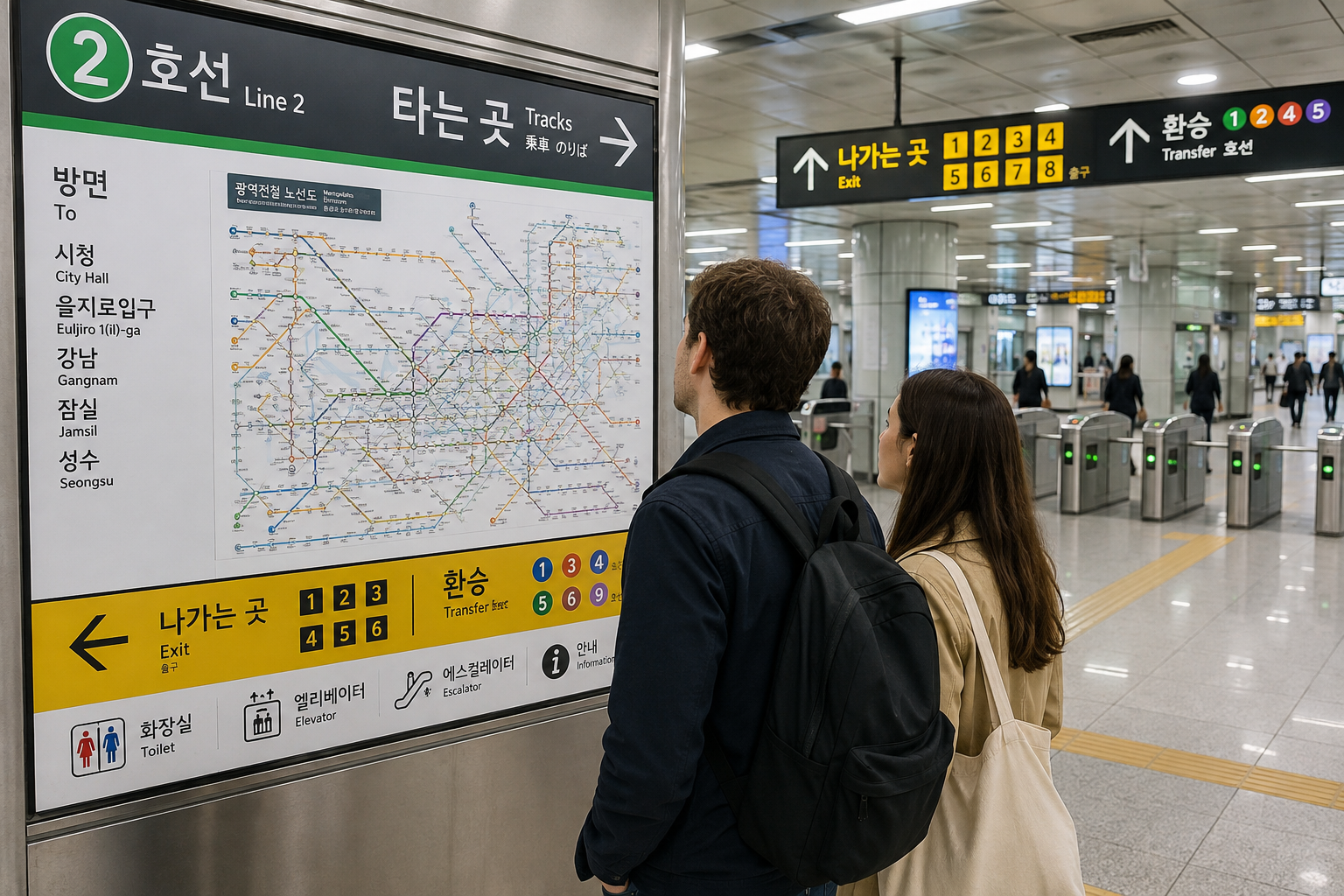
The Seoul subway map can look overwhelming the first time you see it. With dozens of lines, transfer stations, and unfamiliar station names, you might wonder, “How am I supposed to figure this out?”
The good news? Using the Seoul subway is much easier than it looks.
You do not need to memorize the entire subway map. You just need to know which transportation card to use, how to choose the right direction, where to transfer, and one thing many first-time visitors overlook — which exit to take.
This guide covers what you actually need to know to use the Seoul subway confidently on your first trip to Korea.
Quick Answer
🚇 First trip to Seoul?
A T-money card is usually the easiest and most flexible option for using subways and buses.
💳 Staying mainly in Seoul and using public transportation many times a day?
Compare the Climate Card before deciding which transportation card to buy.
🚪 One rule every first-time visitor should remember:
Always check the exit number before leaving the station.
Is the Seoul Subway Easy for Tourists?
Yes — once you understand a few basics.
Seoul has one of the most extensive public transportation systems in the world, but it is surprisingly manageable for international visitors.
Most subway stations display signs in both Korean and English, subway lines are clearly identified by numbers and colors, and many trains provide multilingual announcements.
You do not need to memorize the entire subway map. Instead, focus on three things:
Station Name → Line Number & Color → Direction
Before boarding, check your destination and look at the stations shown in the direction you are traveling.
This simple habit prevents one of the most common mistakes first-time visitors make — getting on the correct subway line but traveling in the wrong direction.
If you are unsure which platform to use, check the name of the next station shown in Naver Map and compare it with the signs inside the station.
How Much Does the Seoul Subway Cost in 2026?
As of 2026, the standard adult base fare on the Seoul subway is ₩1,550 when using a transportation card.
A single-use ticket costs ₩1,650. If you travel a longer distance, an additional distance-based fare may be added.
For most visitors, using a transportation card is much more convenient than buying a single-use ticket every time you ride.
| Payment Method | Adult Base Fare | Best For |
|---|---|---|
| Transportation Card | ₩1,550 | Most travelers |
| Single-Use Ticket | ₩1,650 | Occasional subway rides |
Do not choose an unlimited transportation pass just because it sounds cheaper. If you only take the subway two or three times a day, a regular T-money card may cost less overall.
T-Money vs Climate Card — Which Should You Buy?
For first-time visitors, this is one of the most important transportation choices to understand.
Both cards can make getting around Seoul easier, but they are useful in different situations.
| Item | T-Money | Climate Card |
|---|---|---|
| Best For | Travelers moving around Seoul and other parts of Korea | Travelers staying mainly in Seoul |
| Payment Style | Pay per ride | Unlimited use during the selected period |
| Flexibility | Very flexible | Best when your travel is focused on Seoul |
| Best Choice If… | Your number of rides changes from day to day | You expect to use public transportation many times a day |
Which one should you choose?
Choose T-Money if:
You want the simplest and most flexible option, especially if you plan to travel outside Seoul.
Choose the Climate Card if:
You are staying mainly in Seoul and expect to take buses and subways frequently throughout the day.
Do not automatically choose the Climate Card because it offers unlimited rides. If your sightseeing plan involves long walks and only a few subway trips each day, T-Money may still be the better value.
Where to Buy and Recharge a T-Money Card
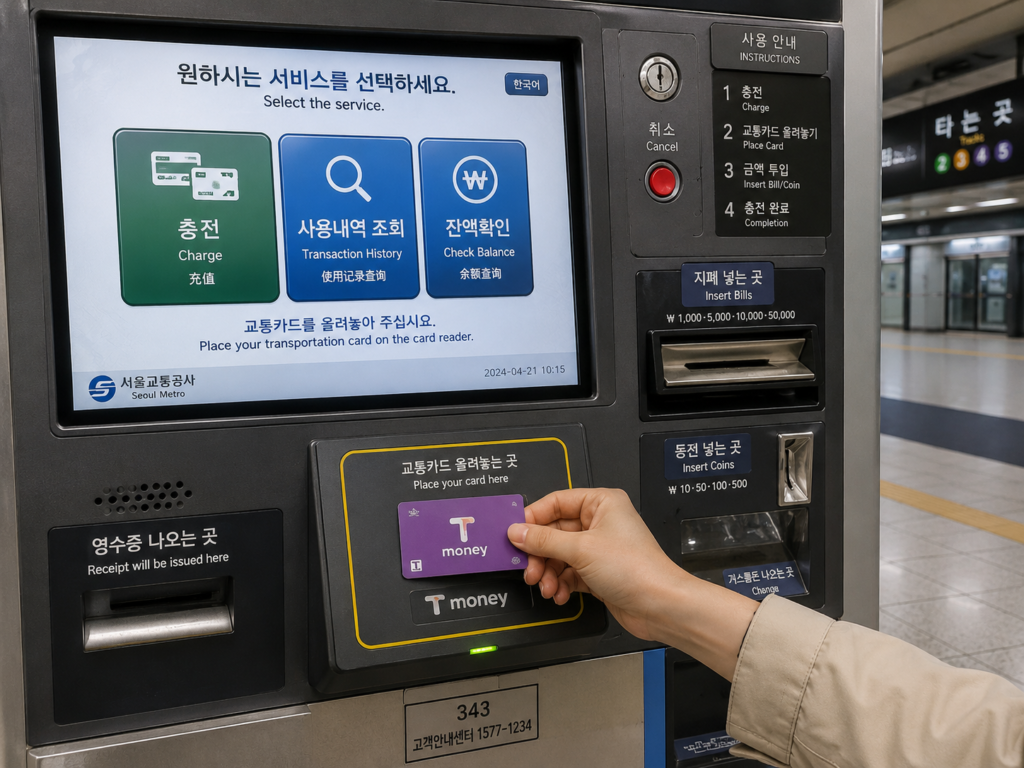
T-money cards are easy to find once you arrive in Korea. You can usually buy one at major convenience stores such as CU, GS25, and 7-Eleven, as well as at other authorized T-money retailers.
After buying the card, you need to add money before using it on the subway or bus. You can recharge a standard T-money card at subway station recharge machines and many convenience stores.
Buying and Using T-Money
1. Buy the card
Look for a T-money card at a convenience store or other authorized retailer.
2. Add money
Recharge the card before your first subway or bus ride.
3. Tap when you enter
Place the card on the reader at the subway gate.
4. Tap again when you exit
Your fare is calculated automatically.
Keep some Korean won in cash with you. Standard T-money cards are commonly recharged with cash at subway station machines and convenience stores, which can surprise travelers who expect to use a credit card for everything.
You do not need to load a huge amount of money onto the card at once. For a first-time visitor, adding a reasonable amount and recharging it later when the balance gets low is usually easier.
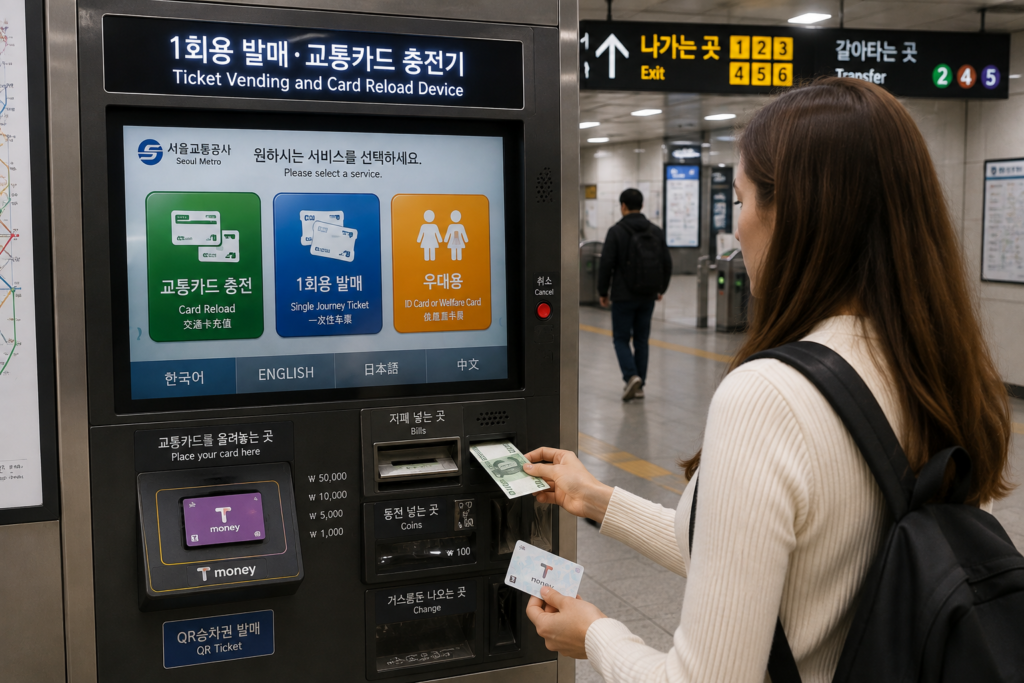
How to Ride the Seoul Subway Step by Step
Once you have your transportation card, using the Seoul subway is quite simple. You do not need to understand the entire subway system — just follow these steps one at a time.
Step 1. Find the Correct Station and Line
Check the station name and subway line number in your navigation app before entering the station. Some stations serve several different subway lines, so the line number and color are just as important as the station name.
Step 2. Tap Your Transportation Card
Place your T-money, Climate Card, or other compatible transportation card on the reader at the subway gate. Wait for the gate to open before walking through.
Step 3. Check the Direction Before Going to the Platform
This is important. Finding the correct subway line does not necessarily mean you are heading in the correct direction. Check the station names shown on the signs and compare them with your route.
Step 4. Board the Train
Once you are on the train, watch the electronic displays and listen for station announcements. Major station information is commonly provided in English as well as Korean.
Step 5. Follow the Transfer Signs
If your route requires a transfer, get off at the transfer station and follow signs marked Transfer / 환승 for your next subway line.
Step 6. Get Off at Your Destination
Check the station name before getting off, especially at stations with similar-sounding names.
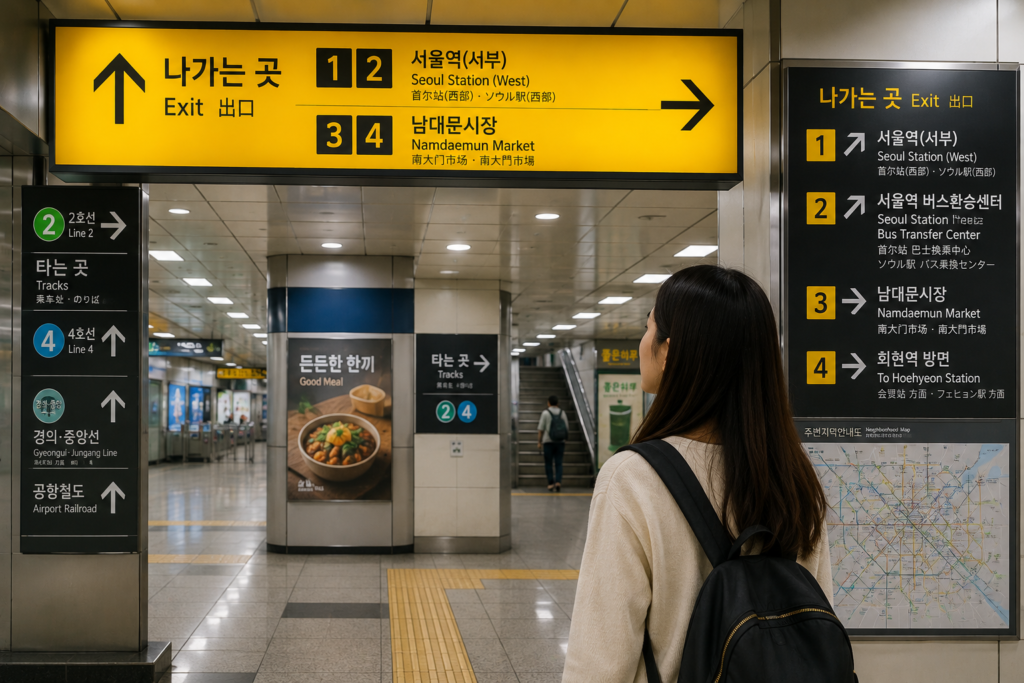
Step 7. Check Your Exit Number
Before leaving the station, check which exit is closest to your destination. At large stations, choosing the wrong exit can add a surprisingly long walk.
Step 8. Tap Your Card Again When You Exit
Tap your transportation card on the gate reader when leaving the station. The correct fare will be calculated automatically.
Before you go underground, take a quick screenshot of your route or check the next station name in your navigation app. It makes finding the correct platform much easier, especially at large transfer stations.
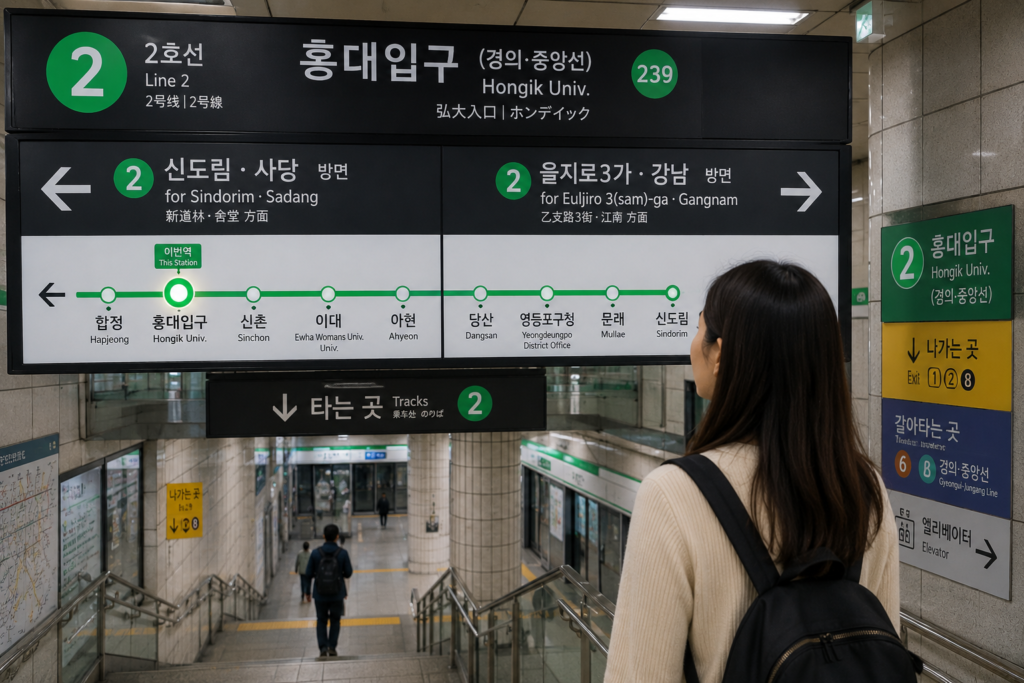
How to Know Which Direction to Take
Finding the correct subway line is only half the job. You also need to make sure you are traveling in the correct direction.
For example, if your route tells you to take Line 2, there will usually be trains going in two different directions. Choosing the wrong platform can send you away from your destination even though you are on the correct line.
The easiest way to check your direction
1. Open your route in Naver Map.
Check the station you are currently at and the next station on your route.
2. Look at the platform signs.
The signs will show the stations in each direction.
3. Match the next station name.
If the next station shown on the sign matches the next station in your app, you are going the right way.
4. Check once more before boarding.
A quick second check can save you from having to get off and travel back in the opposite direction.
Do not worry too much about understanding terms such as clockwise, counterclockwise, eastbound, or westbound. For most first-time visitors, checking the next station name is much easier and more reliable.
If you are still unsure, look at the list of stations displayed above the platform entrance. Your destination does not need to be shown — just confirm that the next station on your route appears in the correct direction.
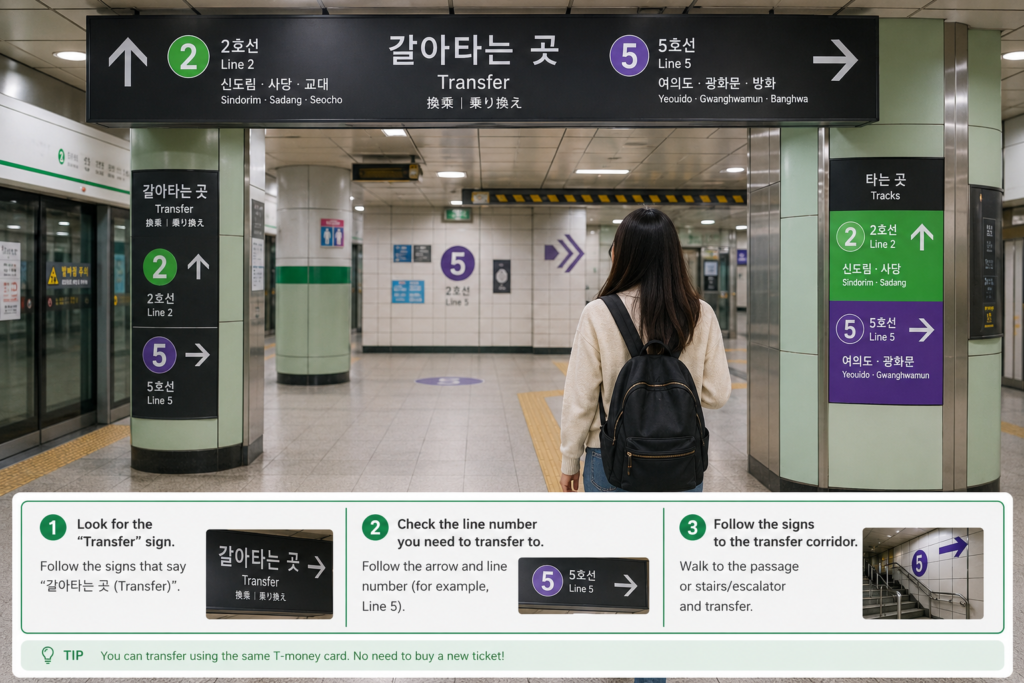
How Subway Transfers Work
Transferring between subway lines in Seoul is usually easier than it looks. You normally do not need to leave the station or buy another ticket.
When you arrive at your transfer station, get off the train and look for signs marked Transfer / 환승. Then follow the number and color of the subway line you need next.
How to Transfer
1. Get off at the transfer station.
Your navigation app will tell you which station to transfer at.
2. Look for “Transfer / 환승” signs.
Do not follow the exit signs unless you actually want to leave the station.
3. Follow the line number and color.
Large stations may serve several subway lines, so make sure you are following the correct one.
4. Check the direction again.
When you reach the next platform, confirm the direction by checking the next station name.
5. Board your next train.
In most cases, you simply continue your journey without buying another ticket.
One thing first-time visitors often underestimate is how far you may need to walk during a transfer.
At some large stations, changing lines can mean walking through long underground corridors, using escalators, and going up or down several levels. A transfer that looks instant on a subway map may take several minutes in real life.
When planning your schedule, allow a little extra time for transfers at large stations. And remember: “Transfer / 환승” means change lines, while “Exit / 나가는 곳” takes you out of the station.
Best Subway Apps for Seoul
A good navigation app can make using the Seoul subway much easier, especially if it is your first time in Korea.
For most international visitors, Naver Map is one of the most useful apps to install before arriving in Seoul.
Why Naver Map Is Useful for the Seoul Subway
Subway routes
Enter your destination and the app can show which subway line to take and where to transfer.
Travel time
You can compare different routes and see the estimated time for your journey.
Transfer information
The app helps you identify the station where you need to change lines.
Exit numbers
For many destinations, you can check which subway exit is most convenient before leaving the station.
Walking directions
After leaving the subway, you can continue following the route to your hotel, restaurant, attraction, or other destination.
KakaoMap is another useful Korean navigation app and can be a good alternative. For a first trip, however, you do not need to install every map app available.
If Naver Map works well for you, it can handle most of the subway and walking navigation you will need during a typical trip to Seoul.
Google Maps can still be useful for finding places, checking reviews, and saving locations, but do not assume that its navigation experience in Korea will always be the same as what you are used to in other countries.
Save your hotel and a few important places in your map app before you start exploring. When taking the subway, check not only the station name but also the line, direction, transfer station, and exit number.
Using the Subway With Large Luggage
Yes, you can bring a suitcase onto the Seoul subway. But there is a big difference between “Can I?” and “Is it convenient?”
If you are traveling with one manageable suitcase outside rush hour, the subway is usually fine. The situation can be very different if you have several large bags, need to make multiple transfers, or are traveling during a busy commuting period.
Before Taking the Subway With Luggage
Check how many transfers you need.
One direct subway ride with a suitcase can be easy. Two or three transfers through large stations can be exhausting.
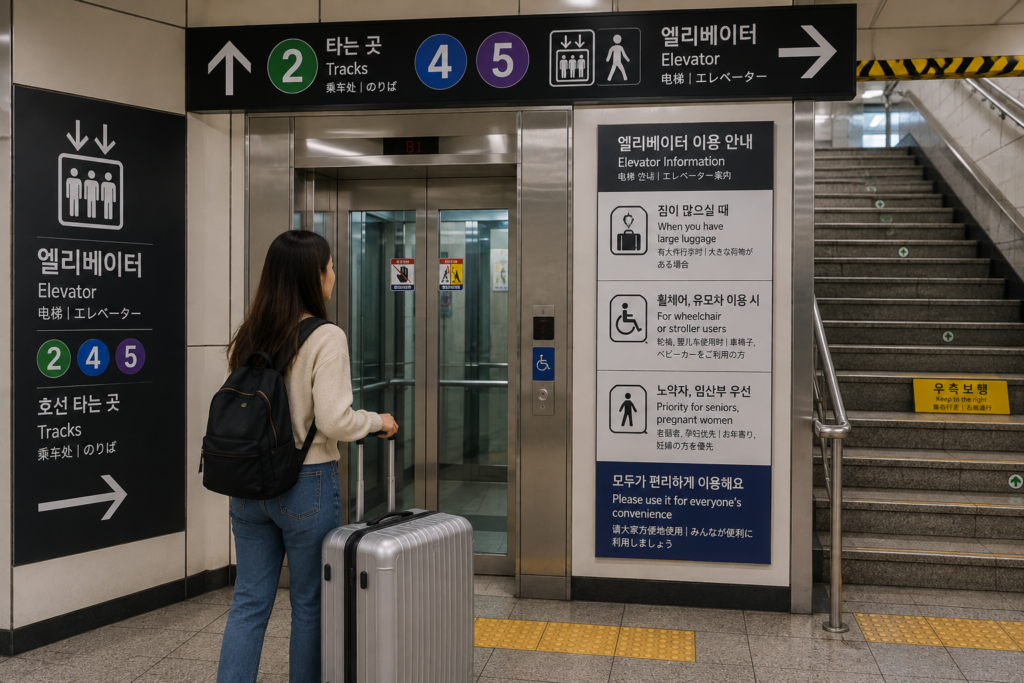
Look for elevators.
Many Seoul subway stations have elevators, but they may not be located along the shortest route through the station.
Avoid rush hour if possible.
A large suitcase is much harder to manage on a crowded train.
Check your exit before you arrive.
The nearest elevator and the best exit for your hotel may not be in the same part of a large station.
Large stations can involve long underground corridors, escalators, stairs, and several different levels. What looks like a simple transfer on your map can feel very different when you are pulling a 20 kg suitcase behind you.
If you have just arrived after a long flight with several large bags, do not choose the subway only because it is the cheapest option. Depending on your hotel location, an airport train, airport bus, or taxi may make the first part of your trip much easier.
Arriving at Incheon Airport?
Not sure whether to take the AREX, airport bus, subway, or taxi? Read our Incheon Airport to Seoul transportation guide →
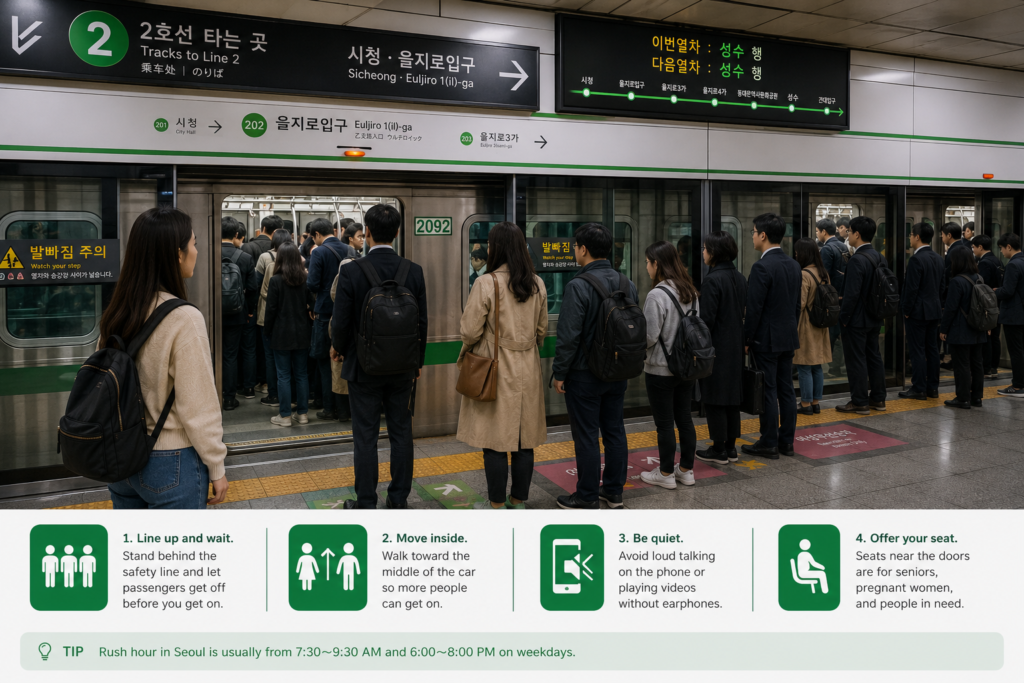
Rush Hour and Subway Etiquette
Seoul’s subway is efficient, but during rush hour it can become extremely crowded. If your schedule is flexible, avoiding the busiest commuting periods can make your trip much more comfortable.
This is especially worth considering if you are traveling with children, carrying shopping bags, or moving around Seoul with a large suitcase.
Simple Subway Etiquette in Seoul
Let passengers get off first.
Wait beside the doors and allow passengers to leave the train before you board.
Do not block the doors.
If you are traveling several stops, move farther inside the train when possible.
Keep your voice down.
Loud conversations and phone calls can stand out on a relatively quiet subway car.
Be careful with backpacks and luggage.
Large bags can easily bump into other passengers on a crowded train.
Pay attention to designated seats.
You will see seats reserved or designated for elderly passengers, pregnant passengers, and others who may need them.
You may also notice people forming lines on the platform before the train arrives. Follow the floor markings or the people already waiting, and leave space in front of the doors so passengers can get off first.
If you are sightseeing rather than commuting, there is usually no reason to squeeze onto the busiest train of the day. When possible, plan longer subway journeys outside the morning and evening rush, especially when carrying luggage.
What to Do If You Enter the Wrong Gate
It happens more often than you might think. You tap your card, walk through the gate, and then realize that you entered the wrong side or followed the wrong direction.
If this happens, do not panic and do not keep walking just because you have already entered. The easiest solution is usually to ask a station staff member for help.
What Should You Do?
1. Look for the station office or a staff member.
Many subway gates have a station office or assistance point nearby.
2. Show where you are trying to go.
If explaining the problem in English is difficult, simply show your destination on your phone.
3. Tell the staff you entered the wrong way.
You do not need to explain everything in Korean. One short sentence is enough.
4. Follow the staff member’s instructions.
They can help you get back to the correct side or explain how to reach the right platform.
Useful Korean Phrase
잘못 들어왔어요.
Jal-mot deu-reo-wat-seo-yo.
Meaning: I entered the wrong way.
If you are not comfortable speaking Korean, show the station staff your destination in Naver Map and say “잘못 들어왔어요”. That is usually enough to make the situation clear.
Do not worry about speaking perfect Korean. In situations like this, showing your destination on your phone and using one simple Korean phrase is often more useful than trying to explain a long sentence.
Common Mistakes First-Time Visitors Make
The Seoul subway itself is not usually the difficult part. Most problems happen because of a few small mistakes that are easy to avoid once you know about them.
7 Common Subway Mistakes
1. Checking the line but not the direction
You can be on the correct subway line and still travel in the wrong direction. Always check the next station before boarding.
2. Ignoring the exit number
At large stations, using the wrong exit can leave you several blocks away from your destination.
3. Assuming you can recharge T-money with a credit card
Keep some Korean won available because standard T-money cards are commonly recharged with cash.
4. Underestimating transfer time
Some transfer stations require several minutes of walking through long underground corridors.
5. Taking large luggage during rush hour
A suitcase that feels manageable at the airport can become difficult to move through a crowded subway station.
6. Following “Way Out” when you need to transfer
If you need another subway line, follow Transfer / 환승 signs instead of Exit / 나가는 곳.
7. Waiting until the last second to check your route
Check your next station, transfer, and exit before you need them. It is much easier than trying to figure everything out while standing in front of a busy subway gate.
Before every subway trip, take 10 seconds to check four things: line → direction → transfer → exit. That simple habit prevents most of the mistakes first-time visitors make on the Seoul subway.
Useful Korean Words You’ll See in the Subway
You do not need to speak Korean to use the Seoul subway. However, recognizing a few Korean words can make navigating stations much easier — especially when you are looking for an exit, transfer, restroom, or elevator.
These are some of the words you are most likely to see while using the subway in Korea.
| Korean | Romanization | Meaning | Where You’ll See It |
|---|---|---|---|
| 출구 | Chul-gu | Exit | Exit signs and station maps |
| 입구 | Ip-gu | Entrance | Station entrances |
| 환승 | Hwan-seung | Transfer | Transfer corridors and signs |
| 타는 곳 | Ta-neun got | Boarding area | Signs leading toward platforms |
| 나가는 곳 | Na-ga-neun got | Way Out | Signs leading toward station exits |
| 화장실 | Hwa-jang-sil | Restroom | Station facility signs |
| 엘리베이터 | El-li-be-i-teo | Elevator | Accessibility and station signs |
The Two Words Worth Remembering
If you remember only two Korean subway words, make them:
환승 (Hwan-seung) = Transfer
출구 (Chul-gu) = Exit
You will often see English together with Korean in Seoul subway stations, so memorizing these words is not necessary. But recognizing them can help you understand signs more quickly when the station is crowded or you are in a hurry.
Do not try to memorize every Korean word before your trip. Start with words you will actually see and use. 환승 (transfer) and 출구 (exit) are two of the most useful words to recognize in the Seoul subway.
Final Seoul Subway Tips
The Seoul subway may look complicated on your first day, but after just a few rides, it usually starts to feel surprisingly simple.
You do not need to memorize the subway map or understand every station. Just remember a few practical habits and let your navigation app handle the rest.
Before Every Subway Ride, Remember:
✓ Use a transportation card instead of buying a single-use ticket every time.
✓ Check the line and direction before going down to the platform.
✓ Check the next station name if you are unsure which direction to take.
✓ Follow “Transfer / 환승” signs when changing subway lines.
✓ Check your exit number before leaving the station.
✓ Keep some Korean won available for situations such as recharging a standard T-money card.
✓ Use a Korea-friendly navigation app to check your route, transfers, and walking directions.
And if you accidentally take the wrong train or miss your stop, do not worry. Simply get off at the next station, check your route again, and continue your journey.
After a few subway rides, things that seemed confusing on your first day — line colors, transfers, platform directions, and exit numbers — will quickly start to make sense.
Do not try to understand Seoul’s entire subway system before your trip. Learn how to complete one journey at a time. Check your line, direction, transfer, and exit — and Seoul becomes much easier to explore.
Enjoy Seoul — and do not let the subway map scare you.
Frequently Asked Questions
Here are quick answers to four common questions first-time visitors often have about using the Seoul subway.
Can tourists use the Seoul subway easily?
Yes. Most major subway stations have English signage, and navigation apps such as Naver Map can help you check the correct line, direction, transfer station, and exit.
Should I buy T-money or a Climate Card?
T-money is usually the more flexible choice, especially if you plan to travel outside Seoul or do not know how many rides you will take each day. A Climate Card can be useful if you are staying mainly in Seoul and expect to use public transportation frequently.
Can I bring a large suitcase on the Seoul subway?
Yes, but large luggage can be inconvenient during rush hour or when your route requires several transfers. If you have multiple large bags, compare the subway with the airport railroad, airport bus, or taxi.
What should I do if I take the subway in the wrong direction?
Get off at the next station, check your route again, and take the train in the opposite direction. It is a common mistake and usually easy to fix.