Free Korean Saju Reading — Four Pillars & Five Elements

Free Korean Saju Reading
Discover Korean Saju, the traditional Four Pillars system used in Korea to explore personality, relationships, strengths, career tendencies and life patterns. Enter your birth information below to discover your Four Pillars, Day Master and Five Elements.
Free Korean Saju Calculator
Discover your Four Pillars, Day Master and Five Elements through Korean Saju — a traditional Korean system of birth-chart interpretation.
If you spend enough time in Korea, you may hear someone ask, “Have you ever had your Saju read?”
Saju (사주) is a traditional Korean way of exploring personality, relationships, career tendencies, and life patterns using your birth date and time.
Even today, some Koreans visit Saju readers or fortune-telling cafés out of curiosity, for fun, or when thinking about relationships, marriage, careers, and other important moments in life.
You don’t need to understand complicated traditional theories to enjoy it. Think of Saju as one of the many interesting ways to experience Korean culture.
Saju in Korean Culture
Fortune-telling has long been a familiar part of Korean culture, and you can still see it today in Saju cafés, traditional fortune-telling shops, TV shows, movies, and everyday conversations.
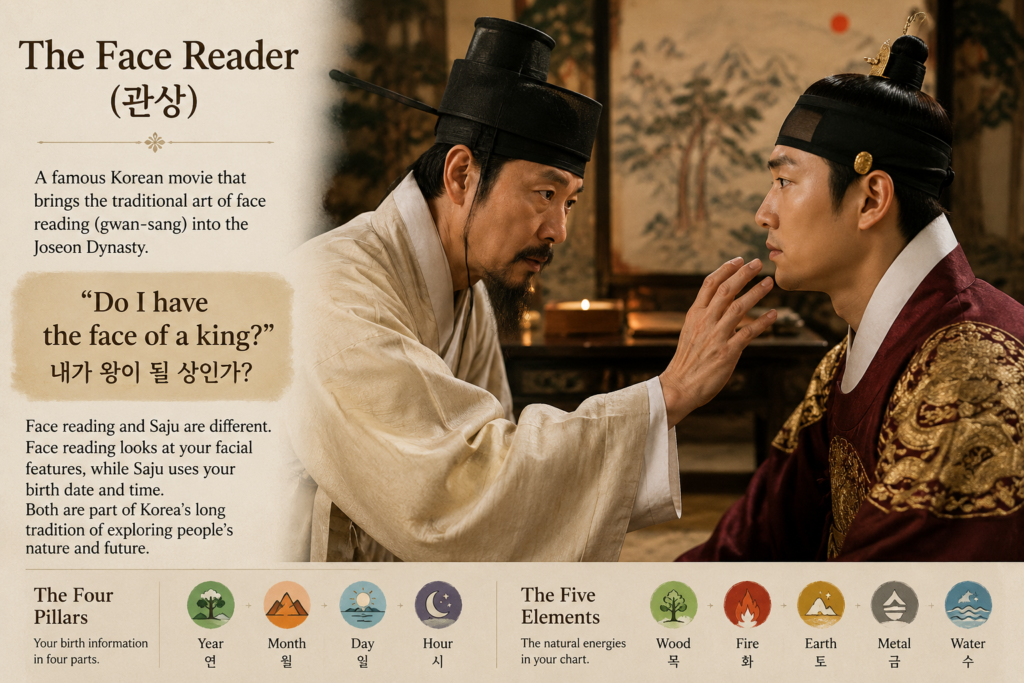
A fun example is the famous Korean movie The Face Reader (관상). The story revolves around a man who reads people’s faces and becomes caught up in a struggle for power. One line from the movie became especially famous in Korea:
“Do I have the face of a king?”
In Korean: “내가 왕이 될 상인가?”
Face reading (관상) and Saju are different traditions. Face reading interprets facial features, while Saju uses your birth date and time. But both reflect a long-standing Korean curiosity about personality, fortune, relationships, and what the future might hold.
So when you try Korean Saju, you’re not just taking an online personality test — you’re getting a small taste of a cultural tradition that Koreans have talked about for generations.
What Are the Four Pillars?
The Four Pillars may sound complicated, but the basic idea is surprisingly simple.
Your Saju begins with four parts of your birth information: the year, month, day, and hour you were born. These are called the Four Pillars.
Year · Month · Day · Hour
Each pillar represents a different part of the traditional Saju chart. Together, they are used to explore your personality, natural tendencies, relationships, and life patterns.
You may also see something called your “Day Master” in your result. Think of it as the central point of your Saju chart — one of the key pieces used to understand your overall reading.
Don’t worry about memorizing any of this. Enter your birth information in the free Korean Saju reader above, and it will calculate everything for you.
The Five Elements: Wood, Fire, Earth, Metal & Water
Another part of Korean Saju you’ll notice is the Five Elements, known in Korean as Ohaeng (오행).
They are Wood (목), Fire (화), Earth (토), Metal (금), and Water (수).
Your Saju chart contains a different mix of these five elements. You might have more of one element and less of another — which is why the result above shows them as percentages.
Wood · Fire · Earth · Metal · Water
목 · 화 · 토 · 금 · 수
In traditional Saju, these elements are used to explore different qualities and tendencies in a person’s chart. But having a high or low percentage of an element does not simply mean “good” or “bad.”
The interesting part is seeing your own combination. Which element is strongest in your chart? Which one is lowest?
Check your result above and see what your Five Elements look like.
Why Do Koreans Still Check Saju Today?
Saju isn’t only something from Korea’s past. You can still find it in everyday Korean life today.
Some people check Saju before marriage, when thinking about a new career, starting a business, or simply when they are curious about what the year ahead might bring.
Young Koreans may also visit Saju or fortune-telling cafés with friends or partners just for fun. In popular areas such as Hongdae, you may even come across places offering quick fortune readings while exploring the neighborhood.
You may also hear Koreans talk about Saju compatibility when discussing relationships. Some couples are curious about how well their birth charts match, while others simply enjoy it as an entertaining conversation.
Not everyone in Korea believes in Saju, of course. For many people, it is simply a mix of tradition, curiosity, entertainment, and self-reflection.
That is what makes Korean Saju interesting for travelers too. It offers a small glimpse into a cultural tradition that still appears in modern Korean life.
How Did Your Saju Reading Feel?
Did any part of your Korean Saju reading feel surprisingly accurate?
If you enjoyed your reading, leave a short comment below and tell us what stood out to you.
Even a one-line comment means a lot. 💛
Your feedback helps us improve this free Korean Saju experience for future visitors.
너무 잘맞아요
Good