
Best Korean Seaweed to Buy as Souvenirs: What Tourists Should Know
If you’re looking for a Korean food souvenir that’s light, easy to pack, and genuinely part of everyday life in Korea, gim (Korean seaweed) is one of the easiest choices.
But walk into a Korean supermarket and you’ll quickly notice that not all gim is the same. Some comes in small, ready-to-eat packets. Others are sold as large, plain dried sheets. You’ll also find premium varieties, crispy seaweed flakes, and gift sets in decorative boxes.
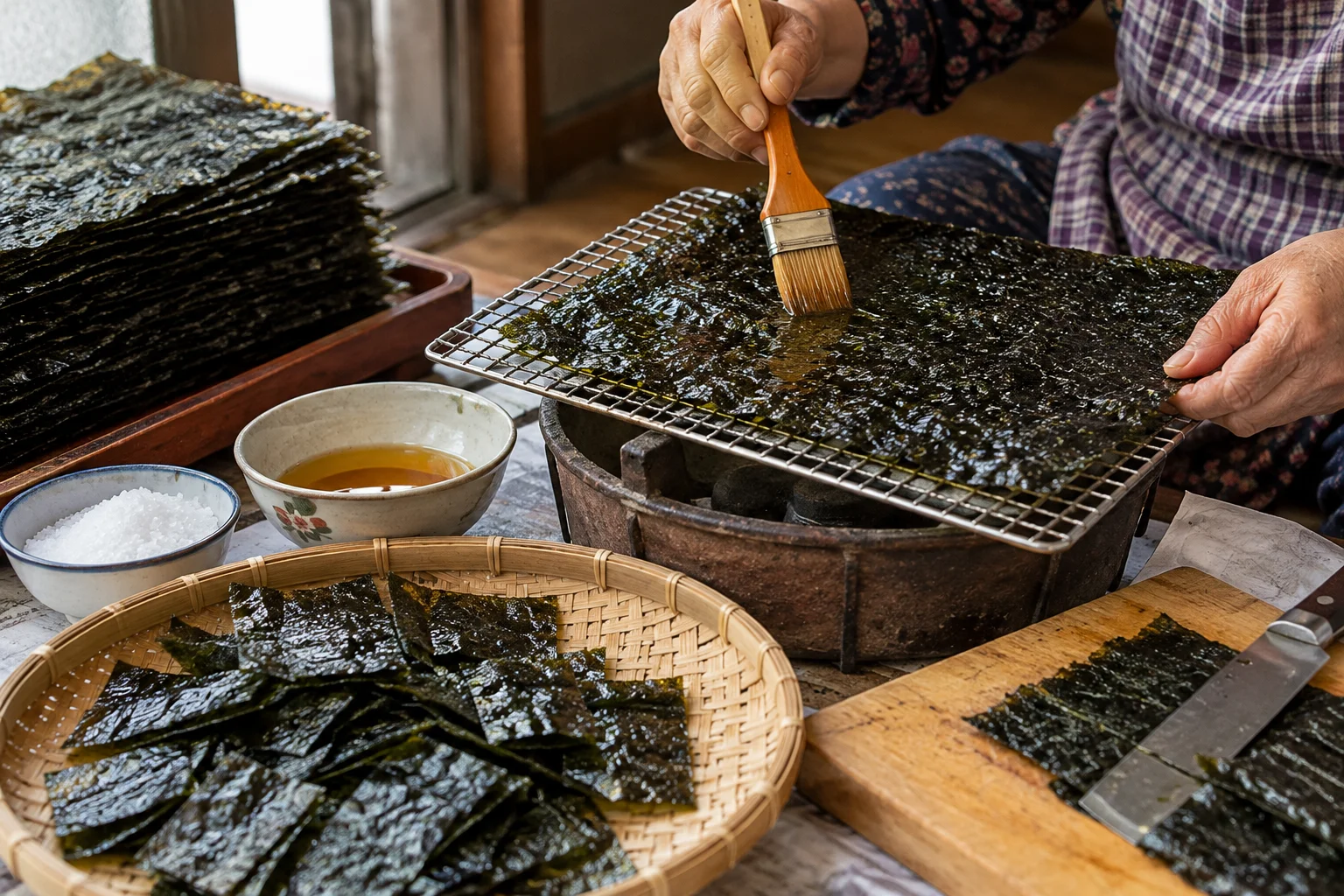
There’s a little history behind those large sheets, too. Before individually packaged seasoned seaweed became so convenient, many Korean families prepared gim at home. They would brush large sheets with sesame oil, sprinkle them with salt, toast them until crisp, and cut them into smaller pieces to eat with rice.
That homemade style is still familiar to many Koreans, and it’s one reason gim is more than just a crunchy snack.
In this guide, I’ll explain which types of Korean seaweed make the best souvenirs, how they differ, where to shop in Korea, and what to consider before packing them in your suitcase.
Quick Answer: Which Korean Seaweed Makes the Best Gift?
For most first-time visitors, individually packaged seasoned gim is the easiest souvenir to buy. It’s ready to eat, simple to share, and available in supermarkets across Korea.
If you want something more special, consider premium gopchang gim. For someone who enjoys cooking Korean food at home, plain dried gim or gimjaban (seasoned seaweed flakes) may be a more interesting choice.
The best option depends on who you’re buying it for. A snack lover, a home cook, and someone receiving a traditional Korean gift may appreciate very different kinds of seaweed.
4 Types of Korean Seaweed Worth Buying as Souvenirs
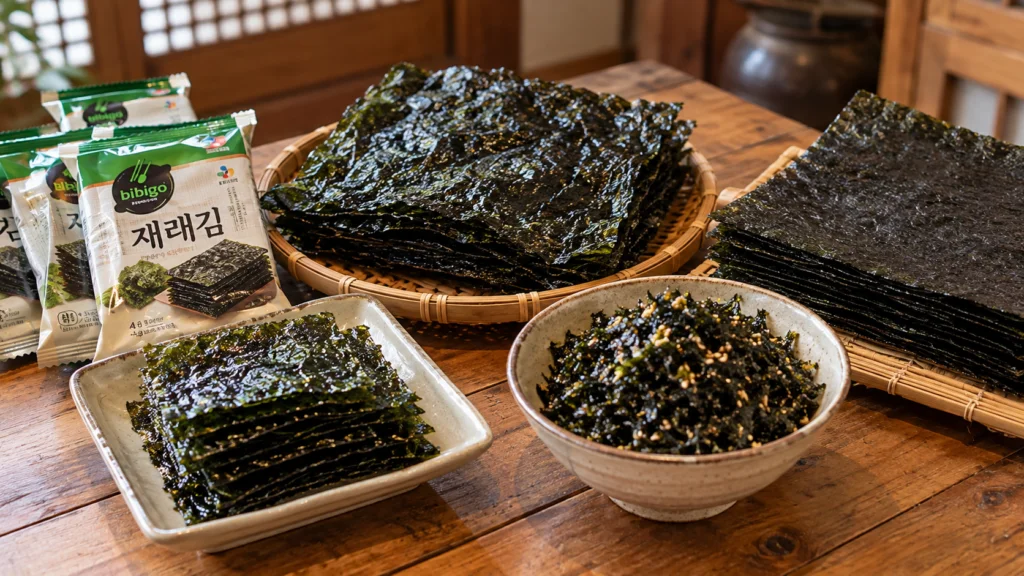
Korean supermarkets usually have an entire section dedicated to gim. The packaging can look similar, but the products inside are often quite different.
Before choosing a gift, it helps to know whether the person receiving it prefers ready-to-eat snacks or enjoys preparing food at home.
| Type | Best For | What to Expect |
|---|---|---|
| Seasoned Gim | Friends, coworkers, first-time visitors | Crispy, salty, ready to eat |
| Gopchang Gim | Family, food lovers, special gifts | Distinctive texture, often sold as a premium product |
| Plain Dried Gim | Home cooks | Large sheets without added seasoning |
| Gimjaban | Rice lovers, families | Seasoned seaweed flakes for topping rice |
1. Seasoned Gim: The Easiest Gift for Almost Anyone
If you’re buying souvenirs for several friends or coworkers, seasoned gim is probably your safest choice.
It’s usually sold in small, individually sealed packets. The seaweed has already been roasted and seasoned with oil and salt, so there’s nothing to prepare.
You’ll see familiar Korean brands such as Yangban and Bibigo, along with supermarket brands and regional producers.
Look for the Korean words 조미김 (seasoned seaweed) on the packaging. Some products use sesame oil, while others use perilla oil or different vegetable oils, so check the ingredients if the recipient has a preference or allergy.
One thing worth knowing: individual packets are easy to share, but multipacks can be bulky. Check how much suitcase space they will need.
2. Gopchang Gim: A More Special Korean Food Gift
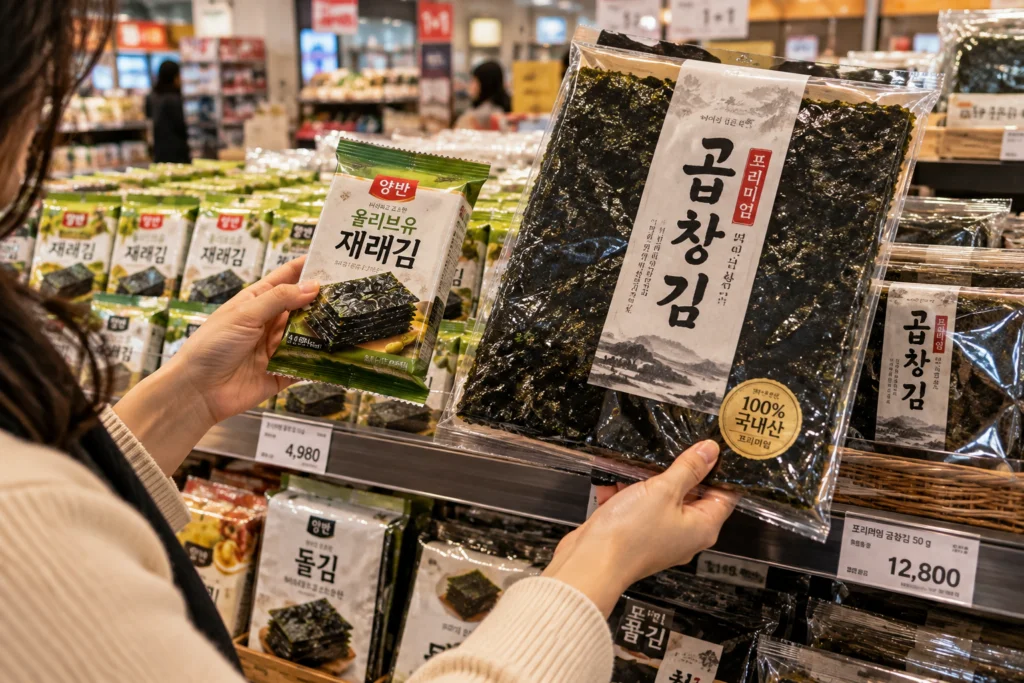
For someone who already enjoys Korean food, gopchang gim (곱창김) is worth considering.
Despite its unusual name, it has nothing to do with beef or pork intestines. The name refers to the naturally curled, irregular appearance of the seaweed, which resembles gopchang.
Gopchang gim is prized for its distinctive texture and is often sold at a higher price than everyday seaweed. You may find it as plain dried sheets, roasted sheets, or seasoned products, so don’t assume every package is ready to eat.
Some varieties come in attractive tins or gift boxes, making them suitable for family members or someone you want to give a more thoughtful souvenir.
However, expensive doesn’t automatically mean better for everyone. Someone who simply wants a salty, crispy snack may prefer ordinary seasoned gim.
3. Plain Dried Gim: The Traditional Way Koreans Enjoyed Seaweed
This is the kind of seaweed that brings back memories of home cooking for many Koreans.
Before convenient, individually packaged seasoned gim became widespread, families often bought large sheets of plain dried seaweed and prepared them themselves.
A common homemade method was to brush the sheets lightly with sesame oil, sprinkle them with salt, and toast them briefly until fragrant and crisp. The sheets were then cut into smaller rectangles and served with warm rice.
That freshly toasted aroma is something you don’t quite get from opening a packet of supermarket seaweed.
If you want to introduce a friend to this part of Korean food culture, look for 마른김 (mareun gim) or 건김 (geon gim), both referring to dried seaweed.
Be careful not to confuse plain dried gim with 김밥김 (gimbap gim). Both may come in large sheets, but gimbap gim is selected and processed for rolling rice and fillings. It’s a useful cooking ingredient, though not necessarily the best choice for someone wanting to make traditional homemade seasoned gim.
Plain dried gim makes a thoughtful gift for someone who enjoys cooking. For a friend who rarely cooks, however, a ready-to-eat seasoned variety is much more convenient.
4. Gimjaban: A Simple Way to Make Rice More Delicious
Gimjaban (김자반) is different from the neat rectangular sheets most travelers associate with Korean seaweed.
It’s made of small pieces or flakes of seaweed, usually seasoned and prepared to be sprinkled over rice.
In Korean homes, gimjaban is an easy addition to a bowl of rice. It can also be used in rice balls, lunchboxes, or simple homemade dishes.
This makes it a practical souvenir for someone who already cooks rice regularly. Just remember that gimjaban can contain more than seaweed, oil, and salt, depending on the product, so it’s worth checking the ingredient label.
For gift shopping, choose a securely sealed package that won’t spill in your luggage. Resealable pouches can be especially convenient once opened.
Where to Buy Korean Seaweed in Korea
You don’t need to visit a specialty shop to find good Korean seaweed. It’s sold almost everywhere in Korea, from neighborhood supermarkets to convenience stores and traditional markets.
However, where you shop can make a difference, especially if you’re buying several packs to take home.
1. Large Supermarkets: Best for Comparing Prices and Varieties
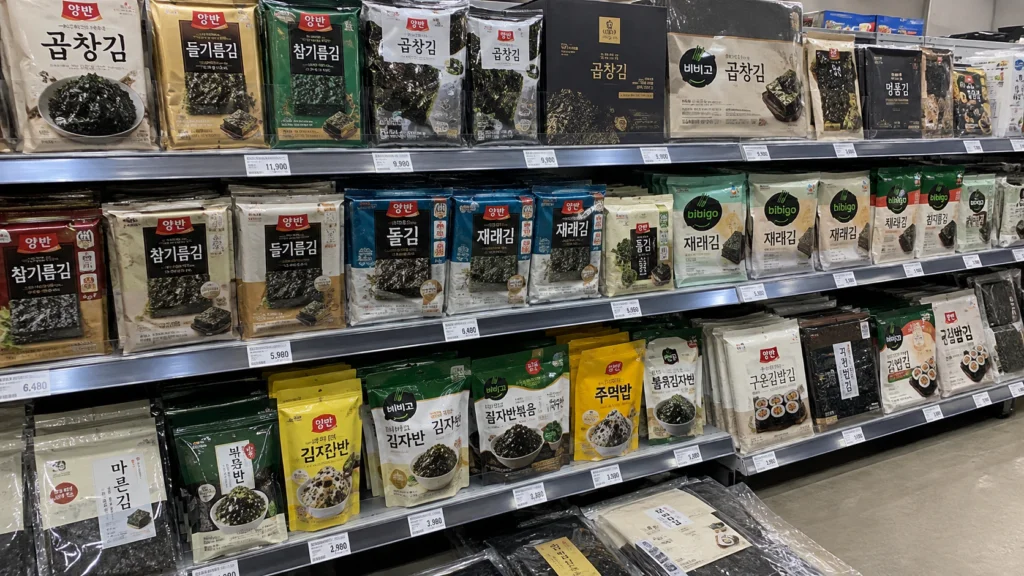
For most travelers, large supermarkets such as Lotte Mart and Emart are the easiest places to shop for Korean seaweed souvenirs.
You’ll usually find a wider selection of seasoned gim, premium seaweed, dried sheets, and gimjaban than you would in a small convenience store.
Supermarkets also make it easier to compare different package sizes, check ingredient labels, and look for multipack deals.
If you’re planning to buy seaweed for several people, compare the total weight and number of individual packets rather than choosing the largest-looking box. Some packages contain a surprising amount of empty space.
My recommendation: If a supermarket is already on your Seoul itinerary, buy most of your seaweed souvenirs there instead of making a separate shopping trip across the city. You can also plan shopping around our Seoul 3-day itinerary.
2. Convenience Stores: Best for Trying Before Buying
Convenience stores such as CU, GS25, and 7-Eleven are useful when you want to try Korean seaweed without buying a large multipack.
You may find small packs of seasoned gim or seaweed-based snacks that are easy to eat with a quick meal.
The selection is usually more limited than in a large supermarket, and the price per gram may be higher.
For that reason, convenience stores are better for sampling a product or picking up a last-minute snack than for buying a large quantity of gifts.
3. Traditional Markets: Worth Exploring for Specialty Seaweed
If you enjoy browsing Korean food markets, look for shops that specialize in dried seafood and seaweed.
Some traditional market vendors sell different grades of dried gim, including varieties that aren’t always easy to distinguish in a regular supermarket.
This can be an interesting place to learn about the difference between everyday dried gim and premium products such as gopchang gim.
However, not every market stall offers the same packaging, prices, or product information. If you’re buying seaweed to take overseas, choose properly sealed products with a clear expiration date and ingredient label.
A traditional market can be a memorable shopping experience, but it isn’t automatically cheaper than a supermarket.
4. Airport Shops: Convenient, but Don’t Rely on Them
Forgot to buy souvenirs before leaving Seoul? You may find Korean seaweed gift packs at airport food and souvenir shops.
Airport shopping is convenient, especially if you only need one or two gifts. However, product selection and prices can differ from those at city supermarkets.
If Korean seaweed is one of the main souvenirs on your list, it’s better to buy it before heading to the airport.
So, Where Should You Actually Shop?
If you’re buying seaweed for friends, coworkers, or family, start with a large supermarket. It’s generally the most practical option for comparing products and buying several packs in one visit.
If you’re curious about traditional dried gim or want a more distinctive food gift, a dried seafood shop at a traditional market may be worth visiting.
And if you simply want to taste Korean seaweed before committing to a bigger purchase, pick up a small packet at a convenience store.
There’s no need to spend half a day searching for a famous seaweed shop. For most first-time visitors, the best place to buy gim is a well-stocked supermarket that’s already along your travel route.
How Much Does Korean Seaweed Cost in Korea?
Korean seaweed can be a surprisingly affordable souvenir, but the price depends on what you’re buying. A multipack of everyday seasoned gim is very different from a premium box of gopchang gim or a large package of dried seaweed.
There is no single standard price for Korean seaweed. Everyday seasoned gim, premium gopchang gim, plain dried sheets, and gimjaban are sold in different weights and pack sizes. Prices also change with the retailer and promotions.
| Type | What to Compare |
|---|---|
| Seasoned gim | Number of individual packets, grams per packet, and total price |
| Gopchang gim | Whether it is plain, roasted, or seasoned; net weight and grade |
| Plain dried gim | Number and size of sheets, net weight, and origin |
| Gimjaban | Net weight, ingredients, and resealable packaging |
If a shelf label shows a unit price per 10g or 100g, use it to compare similar products. A gift set may cost more because of its presentation rather than the amount of seaweed inside.
Don’t Judge the Price by the Size of the Package
This is one of the easiest mistakes to make when buying Korean seaweed.
A large box may contain many tiny packets, while a smaller-looking package may contain full-size sheets. Comparing boxes alone will not tell you which offers better value.
Look for the total weight in grams, the number of individual packs, and the price per 10g or 100g when it’s displayed on the shelf.
Also remember that the cheapest seaweed per gram isn’t necessarily the best gift. Small individual packets are convenient for sharing, while larger sheets can be better for someone who cooks Korean food.
Is Premium Gopchang Gim Worth the Extra Money?
It can be, especially if you’re buying for someone who enjoys trying different Korean foods.
Gopchang gim is often valued for its distinctive texture, but prices vary widely depending on the producer, grade, seasoning, and packaging.
Before paying more, check whether you’re buying plain dried seaweed, roasted seaweed, or a seasoned product. They may all be labeled as gopchang gim, but they’re not used in exactly the same way.
For coworkers or a large group of friends, everyday seasoned gim is usually the more practical option. Save the premium varieties for people who would appreciate the difference.
Three Ways to Avoid Overspending
First, compare the unit price. Check the weight and number of packets instead of choosing the biggest box.
Second, look at multipack promotions. Supermarkets sometimes offer discounts on larger packs, but only buy that quantity if you have enough luggage space and people to give it to.
Third, check the best-before or expiration date. If you’re buying gifts near the beginning of your trip, choose products that will still have plenty of time left when you return home.
For most travelers, a few multipacks of everyday seasoned gim and one or two more distinctive varieties will make a better selection than filling an entire suitcase with the same product.
Can You Bring Korean Seaweed Home? Packing and Customs Tips
Korean seaweed is light, doesn’t need refrigeration when sold as a shelf-stable product, and is easy to carry home. That’s part of what makes it such a practical souvenir.
But there are a few things worth checking before you fill your suitcase with it.
1. Can You Bring Korean Seaweed on a Plane?
Plain dried gim and commercially packaged roasted seaweed are generally treated as solid foods, so they can usually travel in either carry-on or checked luggage.
However, airport security rules and customs import rules are separate. Being allowed to take seaweed onto a plane doesn’t automatically mean you’re allowed to bring it into your destination country.
If you’re carrying seaweed in a jar with liquid seasoning or oil, additional cabin baggage liquid restrictions may apply.
2. How to Pack Seaweed Without Crushing It
The biggest problem with packing gim isn’t its weight. It’s how easily the thin sheets can break.
For small seasoned seaweed packets, keeping the original trays and outer packaging can help protect the contents. If you’re short on space, resist the temptation to remove every protective tray.
Place the packets between soft clothes or inside a rigid container, and avoid putting heavy souvenirs on top.
For large sheets of dried gim, keep them flat if possible. Folding them to fit your suitcase will usually leave you with broken pieces instead of full sheets.
One more tip: keep unopened packages sealed until you’re ready to eat them. Seaweed absorbs moisture easily and can lose its crisp texture.
3. Check Your Home Country’s Food Import Rules
This is the part travelers shouldn’t skip.
Food import rules differ by country, and they may depend on ingredients, processing methods, quantities, and whether the products are intended for personal use.
Commercially packaged dried seaweed is often easier to identify and inspect than loose, unlabeled products, but packaging alone does not guarantee that an item is permitted.
If you’re returning to the United States, check the U.S. Customs and Border Protection food guidance. Agricultural products must be declared, and admission depends on the product and inspection.
For other destinations, including Australia, New Zealand, Canada, and countries in the European Union, check the relevant official customs or biosecurity guidance before traveling. For example, consult Australia’s Department of Agriculture or New Zealand’s Ministry for Primary Industries. Don’t assume the rules are identical.
When in doubt, declare the food and let the customs authorities determine whether it can enter.
4. Choose Sealed Packages With Clear Labels
For overseas gifts, I would choose commercially sealed seaweed with an ingredient list, net weight, manufacturer information, and a clearly printed date label.
If you’re buying premium gim at a traditional market, ask whether the shop has a sealed, labeled version suitable for carrying home.
Also check the ingredients if the person receiving the gift has food allergies or dietary restrictions. Some seasoned seaweed products contain additional flavorings or allergens, and not every variety is suitable for every diet.
5. When Should You Buy Seaweed During Your Trip?
If you’re staying in Seoul for several days, buying seaweed near the end of your trip can make packing easier. You won’t need to carry bulky multipacks between hotels or worry about crushing them while reorganizing your luggage.
If you spot a special variety earlier in your trip, it’s fine to buy it then. Just store it in a cool, dry place and keep it away from moisture and excessive heat.
My suggestion is simple: buy everyday seasoned gim during your final supermarket visit, and pick up specialty dried gim whenever you find a product you genuinely want to bring home.
Frequently Asked Questions About Korean Seaweed Souvenirs
Is Korean seaweed a good souvenir?
Yes. Korean seaweed is lightweight, widely available, and closely connected to everyday Korean food culture. Individually packaged seasoned gim is particularly convenient when you need small gifts for several people.
The main disadvantages are that the sheets can break easily and multipacks sometimes take up more suitcase space than expected.
How long does Korean seaweed last?
Shelf life varies depending on the product, packaging, and storage conditions. Always check the date printed on the package rather than assuming all Korean seaweed lasts the same amount of time.
Keep unopened seaweed in a cool, dry place according to the manufacturer’s instructions. Once opened, protect it from moisture and follow any storage guidance on the label.
Is Korean seaweed vegan or vegetarian?
Plain dried gim contains seaweed without added seasoning and is generally suitable for plant-based diets.
Seasoned gim and gimjaban require a closer look. Some products may contain seafood-derived seasonings or other animal-based ingredients.
If you’re buying for a vegan or vegetarian friend, check the full ingredient list and look for appropriate certification when available.
Does gopchang gim contain intestines?
No. Despite the name, gopchang gim (곱창김) is seaweed, not an animal product.
The word “gopchang” refers to its curled, irregular appearance, which resembles the shape of intestines.
However, if you’re buying a seasoned version, you should still check the ingredients for any added animal-derived seasonings.
What’s the difference between gim and nori?
Gim is the Korean name for edible seaweed sheets, while nori is the Japanese term commonly used for similar seaweed products.
Both are made from edible red algae, but the products you’ll find in stores can differ in seasoning, roasting methods, texture, and intended use.
Korean seasoned gim is often enjoyed with rice as a side dish, while Japanese nori is commonly associated with sushi rolls and rice dishes.
Can I use Korean seaweed to make sushi or gimbap?
Yes, but choose the right type.
For Korean gimbap, look for 김밥김 (gimbap gim), which comes in large sheets designed for rolling rice and fillings.
Small packets of seasoned gim are better for eating with rice or enjoying as a snack. They’re usually too small and delicate for making full-size rolls.
Final Thoughts: Which Korean Seaweed Should You Bring Home?
If it’s your first time shopping for Korean seaweed souvenirs, don’t overcomplicate it.
For friends and coworkers, choose individually packaged seasoned gim. For someone who loves Korean food, consider gopchang gim. And for a home cook, plain dried gim or gimjaban can be a more interesting gift.
One of the nicest things about giving Korean seaweed as a souvenir is that you’re sharing something people in Korea actually enjoy at home. It doesn’t need expensive packaging to make a thoughtful gift.
Buy what suits the person receiving it, keep the packaging protected in your luggage, and check your destination’s food import rules before flying home.
Sometimes the simplest Korean souvenirs are the ones people enjoy the most.
4 Types of Korean Seaweed Worth Buying as Souvenirs
Korean supermarkets usually have an entire section dedicated to gim. The packaging can look similar, but the products inside are often quite different.
Before choosing a gift, it helps to know whether the person receiving it prefers ready-to-eat snacks or enjoys preparing food at home.
| Type | Best For | What to Expect |
|---|---|---|
| Seasoned Gim | Friends, coworkers, first-time visitors | Crispy, salty, ready to eat |
| Gopchang Gim | Family, food lovers, special gifts | Distinctive texture, often sold as a premium product |
| Plain Dried Gim | Home cooks | Large sheets without added seasoning |
| Gimjaban | Rice lovers, families | Seasoned seaweed flakes for topping rice |
1. Seasoned Gim: The Easiest Gift for Almost Anyone
If you’re buying souvenirs for several friends or coworkers, seasoned gim is probably your safest choice.
It’s usually sold in small, individually sealed packets. The seaweed has already been roasted and seasoned with oil and salt, so there’s nothing to prepare.
You’ll see familiar Korean brands such as Yangban and Bibigo, along with supermarket brands and regional producers.
Look for the Korean words 조미김 (seasoned seaweed) on the packaging. Some products use sesame oil, while others use perilla oil or different vegetable oils, so check the ingredients if the recipient has a preference or allergy.
One thing worth knowing: the small plastic trays inside many seaweed packets protect the delicate sheets, but they also take up considerable suitcase space. If you’re buying several multipacks, check how bulky the packaging is before heading to the checkout.
2. Gopchang Gim: A More Special Korean Food Gift
For someone who already enjoys Korean food, gopchang gim (곱창김) is worth considering.
Despite its unusual name, it has nothing to do with beef or pork intestines. The name refers to the naturally curled, irregular appearance of the seaweed, which resembles gopchang.
Gopchang gim is prized for its distinctive texture and is often sold at a higher price than everyday seaweed. You may find it as plain dried sheets, roasted sheets, or seasoned products, so don’t assume every package is ready to eat.
Some varieties come in attractive tins or gift boxes, making them suitable for family members or someone you want to give a more thoughtful souvenir.
However, expensive doesn’t automatically mean better for everyone. Someone who simply wants a salty, crispy snack may prefer ordinary seasoned gim.
3. Plain Dried Gim: The Traditional Way Koreans Enjoyed Seaweed
This is the kind of seaweed that brings back memories of home cooking for many Koreans.
Before convenient, individually packaged seasoned gim became widespread, families often bought large sheets of plain dried seaweed and prepared them themselves.
A common homemade method was to brush the sheets lightly with sesame oil, sprinkle them with salt, and toast them briefly until fragrant and crisp. The sheets were then cut into smaller rectangles and served with warm rice.
That freshly toasted aroma is something you don’t quite get from opening a packet of supermarket seaweed.
If you want to introduce a friend to this part of Korean food culture, look for 마른김 (mareun gim) or 건김 (geon gim), both referring to dried seaweed.
Be careful not to confuse plain dried gim with 김밥김 (gimbap gim). Both may come in large sheets, but gimbap gim is selected and processed for rolling rice and fillings. It’s a useful cooking ingredient, though not necessarily the best choice for someone wanting to make traditional homemade seasoned gim.
Plain dried gim makes a thoughtful gift for someone who enjoys cooking. For a friend who rarely cooks, however, a ready-to-eat seasoned variety is much more convenient.
4. Gimjaban: A Simple Way to Make Rice More Delicious
Gimjaban (김자반) is different from the neat rectangular sheets most travelers associate with Korean seaweed.
It’s made of small pieces or flakes of seaweed, usually seasoned and prepared to be sprinkled over rice.
In Korean homes, gimjaban is an easy addition to a bowl of rice. It can also be used in rice balls, lunchboxes, or simple homemade dishes.
This makes it a practical souvenir for someone who already cooks rice regularly. Just remember that gimjaban can contain more than seaweed, oil, and salt, depending on the product, so it’s worth checking the ingredient label.
For gift shopping, choose a securely sealed package that won’t spill in your luggage. Resealable pouches can be especially convenient once opened.
Where to Buy Korean Seaweed in Korea
You don’t need to visit a specialty shop to find good Korean seaweed. It’s sold almost everywhere in Korea, from neighborhood supermarkets to convenience stores and traditional markets.
However, where you shop can make a difference, especially if you’re buying several packs to take home.
1. Large Supermarkets: Best for Comparing Prices and Varieties
For most travelers, large supermarkets such as Lotte Mart and Emart are the easiest places to shop for Korean seaweed souvenirs.
You’ll usually find a wider selection of seasoned gim, premium seaweed, dried sheets, and gimjaban than you would in a small convenience store.
Supermarkets also make it easier to compare different package sizes, check ingredient labels, and look for multipack deals.
If you’re planning to buy seaweed for several people, compare the total weight and number of individual packets rather than choosing the largest-looking box. Some packages contain a surprising amount of empty space.
My recommendation: If a supermarket is already on your Seoul itinerary, buy most of your seaweed souvenirs there instead of making a separate shopping trip across the city.
2. Convenience Stores: Best for Trying Before Buying
Convenience stores such as CU, GS25, and 7-Eleven are useful when you want to try Korean seaweed without buying a large multipack.
You may find small packs of seasoned gim or seaweed-based snacks that are easy to eat with a quick meal.
The selection is usually more limited than in a large supermarket, and the price per gram may be higher.
For that reason, convenience stores are better for sampling a product or picking up a last-minute snack than for buying a large quantity of gifts.
3. Traditional Markets: Worth Exploring for Specialty Seaweed
If you enjoy browsing Korean food markets, look for shops that specialize in dried seafood and seaweed.
Some traditional market vendors sell different grades of dried gim, including varieties that aren’t always easy to distinguish in a regular supermarket.
This can be an interesting place to learn about the difference between everyday dried gim and premium products such as gopchang gim.
However, not every market stall offers the same packaging, prices, or product information. If you’re buying seaweed to take overseas, choose properly sealed products with a clear expiration date and ingredient label.
A traditional market can be a memorable shopping experience, but it isn’t automatically cheaper than a supermarket.
4. Airport Shops: Convenient, but Don’t Rely on Them
Forgot to buy souvenirs before leaving Seoul? You may find Korean seaweed gift packs at airport food and souvenir shops.
Airport shopping is convenient, especially if you only need one or two gifts. However, product selection and prices can differ from those at city supermarkets.
If Korean seaweed is one of the main souvenirs on your list, it’s better to buy it before heading to the airport.
So, Where Should You Actually Shop?
If you’re buying seaweed for friends, coworkers, or family, start with a large supermarket. It’s generally the most practical option for comparing products and buying several packs in one visit.
If you’re curious about traditional dried gim or want a more distinctive food gift, a dried seafood shop at a traditional market may be worth visiting.
And if you simply want to taste Korean seaweed before committing to a bigger purchase, pick up a small packet at a convenience store.
There’s no need to spend half a day searching for a famous seaweed shop. For most first-time visitors, the best place to buy gim is a well-stocked supermarket that’s already along your travel route.
How Much Does Korean Seaweed Cost in Korea?
Korean seaweed can be a surprisingly affordable souvenir, but the price depends on what you’re buying. A multipack of everyday seasoned gim is very different from a premium box of gopchang gim or a large package of dried seaweed.
To give you a realistic idea of what Korean seaweed costs, here are a few examples from Korean online retailers. These are reference prices rather than guaranteed in-store prices, and promotions can change what you pay.
| Seaweed Type | Example Package | Reference Price |
|---|---|---|
| Seasoned gim | Bibigo, 4g × 16 packs | ₩6,980 |
| Gopchang gim | Daecheon, 20g × 10 packs | ₩22,000 |
| Gimjaban | Sung Gyung, 50g × 5 packs | ₩13,840 |
Prices checked in October 2026 from Korean online listings. In-store prices, availability, and discounts may differ.
Don’t Judge the Price by the Size of the Package
This is one of the easiest mistakes to make when buying Korean seaweed.
A large box might contain 16 small packets, while a much smaller-looking package may contain full-size sheets. Comparing the boxes alone won’t tell you which one offers better value.
Look for the total weight in grams, the number of individual packs, and the price per 10g or 100g when it’s displayed on the shelf.
Also remember that the cheapest seaweed per gram isn’t necessarily the best gift. Small individual packets are convenient for sharing, while larger sheets can be better for someone who cooks Korean food.
Is Premium Gopchang Gim Worth the Extra Money?
It can be, especially if you’re buying for someone who enjoys trying different Korean foods.
Gopchang gim is often valued for its distinctive texture, but prices vary widely depending on the producer, grade, seasoning, and packaging.
Before paying more, check whether you’re buying plain dried seaweed, roasted seaweed, or a seasoned product. They may all be labeled as gopchang gim, but they’re not used in exactly the same way.
For coworkers or a large group of friends, everyday seasoned gim is usually the more practical option. Save the premium varieties for people who would appreciate the difference.
Three Ways to Avoid Overspending
First, compare the unit price. Check the weight and number of packets instead of choosing the biggest box.
Second, look at multipack promotions. Supermarkets sometimes offer discounts on larger packs, but only buy that quantity if you have enough luggage space and people to give it to.
Third, check the best-before or expiration date. If you’re buying gifts near the beginning of your trip, choose products that will still have plenty of time left when you return home.
For most travelers, a few multipacks of everyday seasoned gim and one or two more distinctive varieties will make a better selection than filling an entire suitcase with the same product.
Can You Bring Korean Seaweed Home? Packing and Customs Tips
Korean seaweed is light, doesn’t need refrigeration when sold as a shelf-stable product, and is easy to carry home. That’s part of what makes it such a practical souvenir.
But there are a few things worth checking before you fill your suitcase with it.
1. Can You Bring Korean Seaweed on a Plane?
Plain dried gim and commercially packaged roasted seaweed are generally treated as solid foods, so they can usually travel in either carry-on or checked luggage.
However, airport security rules and customs import rules are separate. Being allowed to take seaweed onto a plane doesn’t automatically mean you’re allowed to bring it into your destination country.
If you’re carrying seaweed in a jar with liquid seasoning or oil, additional cabin baggage liquid restrictions may apply.
2. How to Pack Seaweed Without Crushing It
The biggest problem with packing gim isn’t its weight. It’s how easily the thin sheets can break.
For small seasoned seaweed packets, keeping the original trays and outer packaging can help protect the contents. If you’re short on space, resist the temptation to remove every protective tray.
Place the packets between soft clothes or inside a rigid container, and avoid putting heavy souvenirs on top.
For large sheets of dried gim, keep them flat if possible. Folding them to fit your suitcase will usually leave you with broken pieces instead of full sheets.
One more tip: keep unopened packages sealed until you’re ready to eat them. Seaweed absorbs moisture easily and can lose its crisp texture.
3. Check Your Home Country’s Food Import Rules
This is the part travelers shouldn’t skip.
Food import rules differ by country, and they may depend on ingredients, processing methods, quantities, and whether the products are intended for personal use.
Commercially packaged dried seaweed is often easier to identify and inspect than loose, unlabeled products, but packaging alone does not guarantee that an item is permitted.
If you’re returning to the United States, remember that travelers must declare agricultural and food products as required by U.S. Customs and Border Protection. Whether a particular seaweed product is admissible depends on the applicable rules and inspection.
For other destinations, including Australia, New Zealand, Canada, and countries in the European Union, check the relevant official customs or biosecurity guidance before traveling. Don’t assume the rules are identical.
When in doubt, declare the food and let the customs authorities determine whether it can enter.
4. Choose Sealed Packages With Clear Labels
For overseas gifts, I would choose commercially sealed seaweed with an ingredient list, net weight, manufacturer information, and a clearly printed date label.
If you’re buying premium gim at a traditional market, ask whether the shop has a sealed, labeled version suitable for carrying home.
Also check the ingredients if the person receiving the gift has food allergies or dietary restrictions. Some seasoned seaweed products contain additional flavorings or allergens, and not every variety is suitable for every diet.
5. When Should You Buy Seaweed During Your Trip?
If you’re staying in Seoul for several days, buying seaweed near the end of your trip can make packing easier. You won’t need to carry bulky multipacks between hotels or worry about crushing them while reorganizing your luggage.
If you spot a special variety earlier in your trip, it’s fine to buy it then. Just store it in a cool, dry place and keep it away from moisture and excessive heat.
My suggestion is simple: buy everyday seasoned gim during your final supermarket visit, and pick up specialty dried gim whenever you find a product you genuinely want to bring home.
Frequently Asked Questions About Korean Seaweed Souvenirs
Is Korean seaweed a good souvenir?
Yes. Korean seaweed is lightweight, widely available, and closely connected to everyday Korean food culture. Individually packaged seasoned gim is particularly convenient when you need small gifts for several people.
The main disadvantages are that the sheets can break easily and multipacks sometimes take up more suitcase space than expected.
How long does Korean seaweed last?
Shelf life varies depending on the product, packaging, and storage conditions. Always check the date printed on the package rather than assuming all Korean seaweed lasts the same amount of time.
Keep unopened seaweed in a cool, dry place according to the manufacturer’s instructions. Once opened, protect it from moisture and follow any storage guidance on the label.
Is Korean seaweed vegan or vegetarian?
Plain dried gim contains seaweed without added seasoning and is generally suitable for plant-based diets.
Seasoned gim and gimjaban require a closer look. Some products may contain seafood-derived seasonings or other animal-based ingredients.
If you’re buying for a vegan or vegetarian friend, check the full ingredient list and look for appropriate certification when available.
Does gopchang gim contain intestines?
No. Despite the name, gopchang gim (곱창김) is seaweed, not an animal product.
The word “gopchang” refers to its curled, irregular appearance, which resembles the shape of intestines.
However, if you’re buying a seasoned version, you should still check the ingredients for any added animal-derived seasonings.
What’s the difference between gim and nori?
Gim is the Korean name for edible seaweed sheets, while nori is the Japanese term commonly used for similar seaweed products.
Both are made from edible red algae, but the products you’ll find in stores can differ in seasoning, roasting methods, texture, and intended use.
Korean seasoned gim is often enjoyed with rice as a side dish, while Japanese nori is commonly associated with sushi rolls and rice dishes.
Can I use Korean seaweed to make sushi or gimbap?
Yes, but choose the right type.
For Korean gimbap, look for 김밥김 (gimbap gim), which comes in large sheets designed for rolling rice and fillings.
Small packets of seasoned gim are better for eating with rice or enjoying as a snack. They’re usually too small and delicate for making full-size rolls.
Final Thoughts: Which Korean Seaweed Should You Bring Home?
If it’s your first time shopping for Korean seaweed souvenirs, don’t overcomplicate it.
For friends and coworkers, choose individually packaged seasoned gim. For someone who loves Korean food, consider gopchang gim. And for a home cook, plain dried gim or gimjaban can be a more interesting gift.
Personally, I think the most meaningful part of giving Korean seaweed as a souvenir is sharing something Koreans actually eat at home. It doesn’t need to come in an expensive gift box to feel special.
Buy what suits the person receiving it, keep the packaging protected in your luggage, and check your destination’s food import rules before flying home.
Sometimes the simplest Korean souvenirs are the ones people enjoy the most.